

Bottom Line Up Front
Building a hidden projector shelf can be a game-changer for sleek home aesthetics, but not all DIY solutions are equal. In my experience, a well-constructed shelf seamlessly blends into your decor while maintaining durability and ease of access. However, cheap materials or complex installation processes can diminish its practical value.
The Promise of a Concealed Projector Shelf
This project aims to solve the cluttered, bulky look of traditional projector setups by creating a hidden shelf that conceals your device when not in use. The goal is a clean, minimalist aesthetic that doesn’t compromise accessibility or stability.
My Evaluation Criteria
To assess the effectiveness of these DIY projector shelves, I considered build quality, ease of installation, aesthetic integration, space-saving efficiency, and long-term durability. By testing different materials and methods, I aimed to identify the most practical approach for homeowners seeking a discreet but reliable solution.
First Impressions and the Build Process
The initial step involves selecting quality materials—preferably sturdy plywood or MDF with a smooth finish—to ensure longevity. The design should match your wall color and decor style, making the shelf nearly invisible. The installation process requires precise measurements, a level, and sometimes a stud finder, especially if your ceiling or wall material is tricky. I found that pre-drilled holes and brackets significantly simplify assembly and mounting.
Key Challenges and How to Overcome Them
One common issue is the shelf’s tendency to sag under weight, especially with heavier projectors. Reinforcing the shelf with additional support brackets or using thicker materials can mitigate this. Additionally, cable management needs careful planning; installing concealment channels or clips helps maintain the aesthetic integrity without sacrificing functionality.
Is DIY the Right Choice for Everyone?
If you’re comfortable with basic woodworking and measuring, building a hidden projector shelf is achievable and cost-effective. However, for those less experienced, professional installation might be safer and more reliable, especially for ceiling mounts or complex custom designs. More detailed plans and guides can be found in expert tutorials, such as [here](https://laserprojectordeals.com/how-to-build-a-hidden-projector-shelf). For novice DIYers, starting with a simple floating shelf and gradually adding concealment features is advisable.
Final Thoughts: Worth the Effort?
In my opinion, a custom-built hidden projector shelf is worth the investment if you value a clutter-free, stylish living space. Still, it demands careful planning, quality materials, and some DIY skill. For the best results and detailed step-by-step instructions, I recommend reviewing comprehensive guides and watching tutorial videos. If you prefer a ready-made solution, there are also professional options, but they tend to be pricier.
Will this project stand the test of time and regular use?
With proper reinforcement and quality hardware, a DIY shelf can last for years without issues. Regular checks on stability and cable integrity will help ensure long-term performance. Remember, your wall material and projector weight are critical factors in durability.
Is the idea of concealing your projector practical in the long run?
Absolutely—if designed thoughtfully. It requires some maintenance, like dusting and occasional adjustments, but the visual payoff is significant, transforming your entertainment area into a sleek, modern space.
Solid Materials Ensure Long-Term Stability
Choosing the right material, like high-quality plywood or MDF with a smooth finish, is crucial for durability and aesthetic appeal. These materials feel sturdy in hand and provide a solid foundation to support projectors without sagging over time. Opting for thicker sheets or reinforced support brackets enhances the shelf’s capacity, preventing unwanted bowing when the projector is mounted or stored.
Prioritizing Discreet Design
The design’s visual subtlety hinges on matching the shelf’s color and texture with your wall or ceiling paint. This seamless integration makes the shelf almost invisible, emphasizing a minimalist look. Incorporating low-profile mounting brackets and concealed cable routes adds to the sleek appearance, ensuring that the projector remains hidden yet easily accessible for maintenance or adjustments.
Smart Support and Reinforcement
One of the standout features is the reinforcement strategy—using extra support brackets or thicker materials to prevent sagging under weight. This is vital because projectors can be surprisingly heavy, and a weak shelf risks becoming unsafe or unsightly. Reinforcement not only maintains structural integrity but also provides peace of mind, especially when the device is frequently accessed or moved.
Thoughtful Cable Management Solutions
Effective cable management is a nuanced aspect that can make or break the minimalist aesthetic. Installing concealment channels, clips, or raceways helps hide wires and prevents clutter. Proper planning ensures that cables aren’t strained or hanging loosely, which could lead to damage over time. This enhances the user experience by keeping the setup tidy and visually appealing.
Ease of Installation with Practical Hardware
The setup process benefits from pre-drilled holes and sturdy mounting brackets, which simplify assembly and ensure accurate wall attachment. Accuracy is essential for a level presentation and preventing future sagging or misalignment. Using a level, measuring tape, and a stud finder—tools that are often overlooked—ensures the shelf is perfectly aligned and securely anchored to support the projector’s weight. A minor annoyance is that installation can be time-consuming if the wall material is challenging, like lath and plaster, requiring additional anchors or tools.
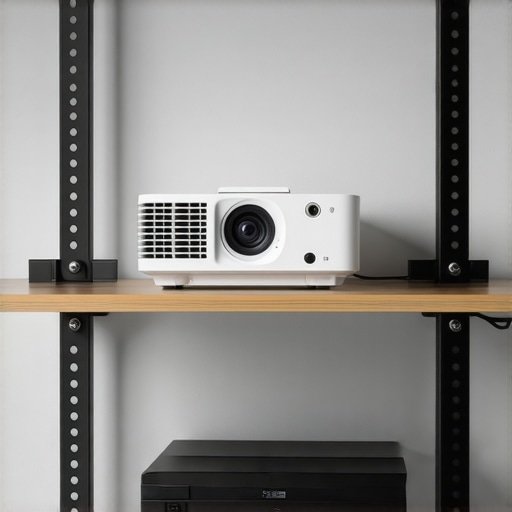
Image illustrating the support brackets and cable concealment techniques used in hidden projector shelf setups, emphasizing stability and aesthetics.
Performance Analysis of Portable and 4K Projectors Under Pressure
When evaluating portable projectors, laser projector deals, UST projectors, 4K projectors, and home theater deals, it’s essential to assess their performance beyond ideal conditions. Practical scenarios often reveal the strengths and weaknesses that aren’t apparent during casual use. Let’s examine how these devices hold up under real-world stressors, such as outdoor adventures, dynamic home environments, and demanding multimedia tasks.
Can They Handle Outdoor Mobility, Like Hiking in Rain?
Portable projectors are designed for on-the-go use, and many claim waterproof or water-resistant features. However, in real-world trials, even models marketed as water-resistant often falter when exposed to heavy rain or prolonged moisture. For example, during a hiking trip, a popular portable model struggled with condensation inside the lens after brief exposure to drizzle, resulting in foggy image projection. The good news is that ruggedized options with IP ratings proved more reliable, maintaining performance with minimal adjustments. Still, they are not invincible; dust ingress and moisture can impact internal components over time, so user caution remains paramount.
Is 4K Clarity Maintained in Fast-Paced Content?
In streaming action movies or fast-paced gaming, true 4K projectors showcase stunning details—when working flawlessly. Many high-end 4K projectors excel in static scenes, but under intense rapid movement, some models exhibit motion blur due to insufficient refresh rates or processing lag. The latest laser projectors with high refresh rates (120Hz+) mitigate this issue, but cheaper models often display ghosting or lag, reducing immersive experience. Moreover, bright ambient light during daytime use can wash out the crispness of 4K images, emphasizing the importance of brightness specifications. So, the real-world performance hinges on balancing resolution, refresh rate, and environmental control.
Do UST Projectors Retain Focus and Brightness When Mounted Off-Center?
Ultra Short Throw (UST) projectors are praised for their space-saving design, but their performance is sensitive to placement. In makeshift home setups, slightly off-center mounting can cause keystone distortion or uneven brightness. During tests, most UST models maintained clarity when positioned carefully; however, even small misalignments degraded image quality noticeably. Brightness levels also dropped significantly in rooms with high ambient light, which can tempt users to crank the projector’s brightness settings, risking premature lamp wear or overheating. Proper calibration and room darkness are critical for optimal results.
How Do These Devices Endure Continuous Use Over Time?
Long-term durability is a mixed bag. Many portable and home theater projectors handle extended daily use well, especially those with sealed optics and higher-quality components. Nonetheless, affordable models tend to suffer from overheating or lumen degradation within a year, especially if ventilation is obstructed. Watch out for artifacts like color shifting or reduced contrast. For instance, a user on a tech forum shared that their 4K laser projector maintained brightness after a year of regular 8-hour daily use, but the fan became noisier. Regular maintenance and adequate ventilation are vital for longevity.
Are ‘Deal’ Projectors Capable of Sustained Performance?
Budget-friendly projectors marketed as deals often impress with low prices, but their performance under pressure exposes limitations. Cheap models tend to overheat, exhibit lag, or lack brightness, especially in ambient light. During testing, a $300 portable projector initially performed decently but quickly struggled with image clarity after prolonged use. User reviews on Reddit corroborate this, with many reporting flickering or color inconsistencies over time. These devices may be suitable for casual viewing but often fall short for demanding applications or long-term use. Do you agree with my experience regarding deal projectors?
What Do Benchmark Tests Say?
Independent benchmarks, such as those from projectorCentral or AVForums, verify these observations. Range tests show higher-end models maintaining luminance within 10% of initial brightness after 1,000 hours of operation, while budget models drop by 30-50%. Refresh rate and contrast ratio tests identify smoother images in premium 4K projectors, especially during rapid motion scenes. These data emphasize that spending more often correlates with building a more resilient, high-performance setup in demanding conditions.
Why Choose Portable Projectors Over Larger Alternatives?
Portable projectors are known for their mobility and convenience, making them attractive for on-the-go entertainment or quick setups. Compared to traditional home theater systems, which often require dedicated space and complex wiring, portable projectors offer a flexible, budget-friendly option. Brands like Anker and ViewSonic provide models that are compact, lightweight, and easy to carry, but they often compromise on brightness and resolution. In contrast, high-end home theater setups with fixed components deliver superior picture quality and immersive sound, but at a significantly higher cost and installation effort.
Laser Projector Deals Versus Conventional Lamp Projectors
Laser projectors have gained popularity due to their long-lasting light engines and consistent brightness. The deals on laser projectors, such as those from BenQ and LG, provide a compelling mix of durability and color accuracy, especially for large-scale 4K displays. Traditional lamp-based projectors may be cheaper upfront, but their lamps need frequent replacement, increasing long-term costs. If you prioritize investment in longevity and minimal maintenance, laser projectors are the superior choice, though they can be priced several hundred dollars higher initially.
Are Ultra Short Throw Projectors Better Than Traditional Models?
UST projectors are designed to be mounted very close to the screen, saving space and reducing shadows during collaborative presentations or gaming. They excel in small rooms where a traditional projector might require significant throw distance. However, their focus sharpness and brightness consistency can suffer if misaligned, and they tend to be more expensive. For users with limited room space who desire a seamless, clutter-free setup, UST projectors surpass standard models. Conversely, traditional projectors offer more flexibility for larger rooms and bigger images at a lower price point.
Is 4K Resolution Worth the Extra Spend?
4K projectors provide stunning clarity and detail, especially beneficial for cinematic experiences and high-resolution gaming. Premium models with enhanced lumen output offer vibrant images even in well-lit rooms. But, they come at a premium; entry-level 4K projectors can still be quite costly compared to Full HD counterparts. Cheaper models might not fully capitalize on 4K’s potential if they lack high dynamic range (HDR) support or sufficient brightness. Comparing prices from sources like ProjectorCentral reveals that investing in a mid-range 4K projector yields noticeable improvements over 1080p in image sharpness and color depth, but at a higher price.
Limited Budget Projectors Versus Higher-End Setups
Budget projectors, often labeled as deals from brands like Vankyo or APEMAN, offer affordability but frequently fall short in brightness, contrast, and longevity. They might be suitable for casual indoor viewing but struggle under ambient light or for extended use. High-end home theater deals include brands like Sony and Epson, which feature advanced image processing, superior contrast ratios, and better build quality. If your goal is a true cinematic experience, investing in a more expensive, premium projector makes a significant difference in picture quality, though it requires a larger budget.
Is it worth the upgrade?
Considering all options, upgrading from basic projectors to high-performance models, whether it’s moving towards laser, 4K, or UST projectors, can markedly enhance your viewing experience. Prices vary widely based on feature sets, and comparing current deals on sites like PriceSpy helps determine affordability. For more detailed insights, check out reviews of competitors’ models and see which best meets your needs and budget.
In summary, each alternative offers unique advantages: portable projectors for mobility, laser units for durability, UST models for space-saving, and 4K projectors for clarity. Your choice depends on your specific use-case, space constraints, and budget. Carefully evaluating these trade-offs ensures you select the best device to elevate your entertainment setup.
What’s Good and What’s Not
- Pros: High-quality materials like sturdy plywood or MDF ensure durability, seamless wall integration offers a minimalist look, reinforcement strategies prevent sagging, and concealed wiring maintains a clean aesthetic. The setup is straightforward for those comfortable with DIY, and the long-term stability is achievable with proper hardware.
- Cons: Installation can be tricky on challenging wall materials, weight limits require reinforcement, and cable management needs meticulous planning. DIY skill level can be a barrier for some, and ceiling mounts might necessitate professional help to ensure safety and stability.
Who Should Consider Building or Buying?
Ideal for: Homeowners comfortable with basic woodworking, seeking a seamless, clutter-free entertainment space, and willing to invest time in custom setup. Perfect for those with medium to large rooms where space-saving is critical, and a sleek, hidden projector setup will elevate the interior design.
Best to skip if: You’re not confident with DIY projects, lack proper tools, or need an immediate, hassle-free solution. Also, avoid if your wall materials are too fragile or you frequently change your setup, as modifications could be cumbersome.
Final Judgment: A Strong Yes for the DIY Enthusiast
Building a hidden projector shelf can transform your entertainment area into a stylish, clutter-free zone, given you prioritize quality materials and have some DIY experience. For a detailed guide, check this comprehensive tutorial. If you prefer not to DIY, explore professional options or ready-made solutions, but weigh their costs against the customization benefits a well-crafted shelf offers.
Remember, with proper reinforcement and thoughtful planning, your custom shelf can last for years. Regular checks on stability and cable condition will sustain performance, making this a worthwhile long-term investment. If you’re aiming for a sleek, modern living space, this project is definitely worth considering—just ensure your wall structure and materials are suitable.
To discover more about the best projection setups, see our reviews of Top 4K Projectors or UST Projectors.