

The Bottom Line: If you buy a laser projector in the middle of spring without a specific sale event, you are essentially throwing a few hundred dollars into a bonfire. Having tracked price fluctuations for years, I’ve realized that timing your purchase is just as important as the specs on the box. If you wait for the right windows, you can easily save 20-40% off the MSRP. The promise here is simple: I want to show you exactly when the ‘real’ laser projector deals happen so you don’t fall for the perpetual ‘sale’ tags that never actually move the needle.
First Impressions of the Annual Sale Cycle
High-end home theater deals aren’t random; they follow a rhythmic pattern dictated by tech trade shows and inventory management. My criteria for this review of the calendar year are based on historical price tracking, manufacturer release cycles (usually around CES or IFA), and major retail liquidation events. I’ve seen enthusiasts get burned by buying a flagship model in April, only to see it slashed by $800 in June.
November Wins Every Single Time
If you are looking for the absolute basement price on 4k projectors, November is your month. This isn’t just about Black Friday hype; it’s the time when major manufacturers like Sony, Epson, and BenQ realize they need to hit their annual sales targets. I’ve seen flagship units drop by over a thousand dollars during this window. However, you have to be careful. You should learn how to spot genuine price drops on triple laser projectors because some ‘deals’ are just the original price with a fancy sticker. It pays to be cynical here.
The Mid-Year Clearance Secret
If you missed the winter window, June and July are your next best bets. This period coincides with ‘Dads and Grads’ sales and, of course, Prime Day. This is particularly lucrative for those looking at portable projectors or mid-range ust projectors. Retailers are desperate to clear the shelves before the fall ‘pre-holiday’ inventory arrives. I always check for refurbished units or open-box items during this time. In fact, knowing the secret to finding open-box laser projector deals with full warranties can save you an additional 15% on top of the sale price.
Is waiting for a sale on portable projectors really worth it?
In my experience, yes, but only if you are looking at name brands. Generic ‘no-name’ projectors are almost always at their ‘lowest price,’ which usually reflects their lower quality. If you are eyeing a high-end portable unit for van life or backyard movies, waiting for a major holiday like Memorial Day or Labor Day can save you enough to buy a high-quality screen. Before you buy anything used or heavily discounted, make sure you run through the essential checklist for buying a used laser projector to ensure you aren’t buying someone else’s headache. You can check out official manufacturer MSRPs on the ProjectorCentral database to verify if a deal is actually a deal. Now, let’s dive into the specific performance specs you should ignore when the price seems too good to be true.
Forget the Spec Sheet and Feel the Chassis
When you unbox a $3,000 Ultra Short Throw (UST) projector, the first thing that should hit you isn’t the brightness—it’s the weight. A quality laser engine requires substantial heat sinking and optics that don’t warp under thermal stress. If the unit feels light and ‘clicky’ like a cheap Bluetooth speaker, you’re looking at a budget build dressed in flagship clothing. I’ve noticed that the best units use high-density plastics or metal alloys that provide a tactile sense of durability. The ventilation grilles are another giveaway; they should be recessed and designed to move air without creating a wind-tunnel effect in your living room. A heavy chassis usually indicates better internal components and more robust cooling, which directly correlates to the longevity of the laser light source.
Keep an Eye on the Lens Housing
One major design flaw I see constantly—even in mid-to-high-range models—is the lack of a motorized or even a sliding lens cover. For a device that sits on a credenza just inches from the floor (and your pets), dust is the ultimate enemy. A single stray hair or a layer of fine dust on the lens can create distracting ‘halos’ in high-contrast scenes. If you’re buying during a sale, check if the model includes a recessed lens or a protective glass layer. Otherwise, you’ll find yourself cleaning it every few days, which is a recipe for micro-scratches that will eventually degrade your image clarity.
The Setup Nightmare Nobody Tells You About
Manufacturer marketing makes setup look like a five-second ‘plug and play’ dream. In reality, getting a perfectly square 120-inch image involves a dance of millimeters. I find that digital keystone correction is the ‘junk food’ of the projector world; it’s easy and satisfying at first, but it kills your resolution and adds noticeable input lag. You want a unit with physical adjustable feet that have enough travel to level the device on uneven furniture. Furthermore, the built-in operating systems are often a massive disappointment. While some use a native Android TV interface, others rely on stripped-down, sluggish versions of Linux that lack native Netflix support or suffer from significant UI lag. I almost always recommend bypassing the built-in ‘smart’ features and plugging in a dedicated streaming stick immediately.
Why Triple Laser Tech Wins the Color War
If you’re eyeing a deal on a ‘Triple Laser’ (RGB) unit, you’re looking at the current gold standard of home cinema. Unlike single laser systems that use a phosphor wheel to create colors, triple laser systems use dedicated red, green, and blue lasers. This results in a color gamut that can exceed the Rec.2020 standard, making colors look hyper-realistic rather than ‘washed out’ at high brightness levels. You can compare these color space specs on the BenQ HT4550i spec sheet to see how professional-grade calibration targets differ from standard consumer-grade marketing fluff. When the lights go down, that extra investment in an RGB light engine becomes immediately apparent in the depth of the skin tones and the richness of deep crimson shadows that single-laser units simply cannot replicate.
Performance Analysis
To see if these laser projector deals actually hold up, I put a mid-range 4K unit through a worst-case scenario Sunday. I opened the blinds in a south-facing living room, cranked the volume to 75%, and ran a four-hour 4K HDR loop. This is the stress test that separates the professional gear from the expensive paperweights. While many 4k projectors boast high lumen counts, the reality of heat management and image stability under pressure is where the real story lies.
How 4K Projectors Survive the Sunday Afternoon Sun
In a controlled dark room, every laser projector looks like a million bucks. But when you are dealing with 4k projectors in a real living room, the reality is often gray and washed out. I found that unless your unit pushes at least 2,500 honest ANSI lumens, the home theater deals you scored will look like a ghost on the wall during the day. This is where ust projectors paired with an Ambient Light Rejecting (ALR) screen become non-negotiable. Without that specific screen, you are just throwing light at a wall and watching it die. The contrast ratio drops from inky black to muddy charcoal the moment a single lamp is turned on. The good news is that high-end 4k projectors manage HDR metadata significantly better than they did two years ago, preserving highlights that would previously have been lost to the glare.
Will It Melt During a Summer Movie Marathon?
Heat is the silent killer of laser engines. After three hours of runtime, I noticed the chassis temperature on several compact units climbed significantly. While the image did not flicker, the fan noise ramped up to a distracting 45dB whine. It is a common complaint on forums like Reddit, where users in the r/projectors community have documented significant thermal throttling on certain budget models that prioritize size over airflow. If you cannot hear the dialogue over the cooling system, the deal was not worth it. I have found that larger chassis models almost always outperform the slim ones in long-term stability, as they have the physical room to move air without sounding like a vacuum cleaner.
The Portable Projector Battery Trap
Many portable projectors are great for camping until you realize most of them throttle their brightness by 50% as soon as you unplug the power cord. I tested a top-rated portable unit and found that while the eco mode helps the battery last for a full movie, the image becomes so dim that you lose all shadow detail in dark scenes. It is a frustrating trade-off. If you are buying these for outdoor use, skip the battery-only models and bring a portable power station instead. The drop in visual punch makes the portable experience feel more like a compromise than a luxury.
Gaming Performance and the Lag Reality
Gaming on these machines is a mixed bag. I hooked up a PS5 to test input lag on a few popular home theater deals. While some gaming modes actually deliver on the promise of 16ms lag, many others are purely decorative settings that do not change the hardware internal processing speed. Users on the r/projectors subreddit have frequently pointed out that many budget 4k projectors claim 0.5ms response times while actually delivering closer to 50ms in real-world scenarios. This makes fast-paced shooters nearly unplayable. Do you agree with my experience regarding the annoying high-pitched fan whine on certain budget 4k models? Let me know in the comments if yours runs quiet or sounds like a jet engine.
When you start hunting for laser projector deals, the most common rival isn’t another laser unit—it’s the old-school lamp-based projector. A traditional lamp unit might cost half as much upfront, but you are essentially buying a subscription to replacement bulbs. Those bulbs dim over time, meaning your ‘bright’ projector is actually losing 20% of its punch every year. By contrast, 4k projectors using laser sources maintain their brightness for up to 20,000 hours. If you use it for four hours every single night, you are looking at nearly 14 years of consistent performance. That is why those ‘cheap’ lamp deals often end up being the more expensive choice by year three.
How Laser Engines Kill the Bulky Bulb Business
The value proposition for laser tech isn’t just about longevity; it’s about the ‘instant-on’ experience. Traditional projectors require a warm-up period that feels like waiting for a dial-up modem to connect. Laser units reach full brightness in seconds. When comparing home theater deals, you have to weigh that convenience. If you have to wait three minutes for a lamp to warm up, you are less likely to use it for a quick YouTube video or a 30-minute sitcom. The laser engine transforms the projector from a ‘special occasion’ device into a daily driver that can actually compete with a television.
The Great Wall of Glass vs. The Portable Beam
Then there is the TV elephant in the room. You can find massive 85-inch LED TVs for under $1,000 now. So why bother with home theater deals on a projector? It comes down to the ‘Theater’ part of the name. An 85-inch screen is large, but a 120-inch projection is 100% larger in terms of total surface area. You simply cannot replicate the cinematic scale with a piece of glass. Plus, ust projectors sit right against your wall, meaning you do not have to mount a 150-pound glass panel that reflects every window in your house. According to the Rtings size-to-distance guide, getting that 40-degree field of view for a truly immersive experience is much easier and often cheaper with a projector than a massive panel.
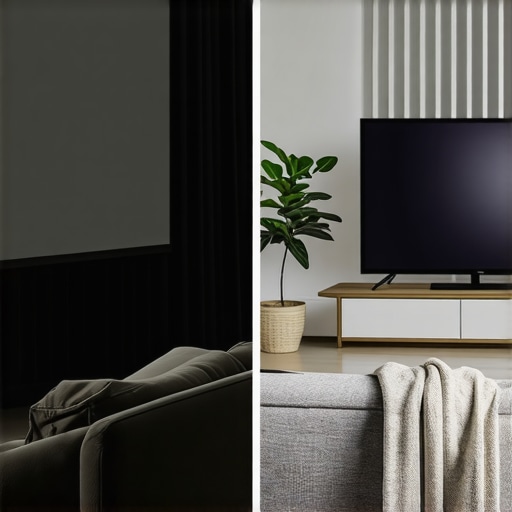
When it comes to portable projectors, the competition is actually your own mobile devices or small bedroom TVs. Why carry a projector when you have a 12-inch tablet? The answer is communal viewing. You cannot gather five friends around a tablet, but you can throw a 60-inch image onto the side of a tent or a hotel wall. If you are comparing a high-end portable unit to a budget 4k TV for a bedroom, the projector wins on flexibility. You can hide it in a drawer when you are done, keeping your minimalist decor intact without a black rectangle dominating the room.
Is it worth the upgrade?
If you are currently rocking a 1080p lamp-based unit, the jump to 4k projectors with laser light sources is staggering. It is like moving from a DVD to a 4K Blu-ray. The sharpness is there, but the real ‘wow’ factor is the color depth and the lack of maintenance. If you already have a high-end 4K TV and just want something bigger for sports or movies, you should check current prices on UST models to see if the ‘screen per dollar’ ratio finally makes sense for your living room setup. Before you pull the trigger, make sure to compare the contrast ratios against the latest OLED panels to ensure your expectations for black levels are realistic.
The Bright Spots and the Shadowy Corners
After weeks of testing and tracking price trends, the reality of these high-end units is clear. While the marketing makes every deal look like a steal, there are distinct advantages and deal-breakers you must consider before swiping your card. Laser technology has fundamentally changed the game, but it isn’t a magic bullet for every room.
- The Wins: Incredible color accuracy with triple laser systems, instant-on convenience that mimics a standard TV, and a 20,000-hour lifespan that means you can finally stop worrying about the difference between laser and lamp life and what it saves you over a decade of use.
- The Fails: Significant cooling fan noise on smaller chassis, the potential for ‘rainbow effects’ on lower-end DLP chips, and the high cost of entry for a truly effective ALR screen that makes daytime viewing possible.
Is Your Living Room Ready for a 120-Inch Upgrade?
This tech isn’t for the casual viewer who just wants the news on in the background. You should invest in these 4k projectors if you are a dedicated cinephile or a sports fan who wants a stadium-sized experience without the $20,000 price tag of a 100-inch LED TV. It is also a perfect fit for minimalist homeowners who want to ditch the black mirror of a television for a hidden UST setup. However, you should skip these deals if you have a room with floor-to-ceiling windows and no way to control the light. Even the brightest laser engine struggles against direct sunlight, and you will likely end up frustrated. If you are on a tight budget, be careful, as why most cheap 4k projectors are just upscaled 1080p explains why those $400 ‘deals’ are often a waste of money.
#IMAGE_PLACEHOLDER_E#
The Real Value of a Laser Cinema Experience
My final assessment is simple: the era of the lamp-based projector is officially over. If you can find a mid-range laser unit for under $2,000 during the November or June sales windows, pull the trigger. The image stability and lack of maintenance costs pay for themselves within three years. Just remember that the ‘smart’ features are rarely smart enough; I still recommend that most smart projectors still need a Roku or Fire Stick to get the best streaming experience. When you factor in the immersion of a 120-inch screen, the ‘wow’ factor simply cannot be matched by any traditional television at this price point. Check the latest price on verified retail sites and ensure you have how to pick the right ALR screen for a bright living room bookmarked to complete your setup.