

The Bottom Line Up Front: If you are running expensive electronics outdoors without a plan for moisture, you are essentially gambling with a thousand-dollar brick. Humidity is the silent killer of portable cinema setups, leading to lens fogging, short circuits, and long-term internal corrosion. The good news? With a few tactical adjustments and the right gear, you can keep the credits rolling even when the air feels like a wet blanket.
The Promise of a Clear Image on a Sticky Night
This guide solves the most frustrating part of backyard movie nights: that inevitable moment when your crisp 4K image turns into a blurry mess because of lens condensation. I have spent dozens of nights testing gear in high-humidity environments to find out what actually keeps a 120-inch image sharp when the dew point starts to climb. Whether you are hunting for the latest laser projector deals or setting up a budget rig, the environmental risks remain the same. My goal is to ensure your hardware survives the night without needing a week in a bowl of rice.
Why Humidity Is the Silent Killer of Outdoor Gear
Most people worry about rain, but humidity is more insidious because it gets inside the chassis. I judge weatherproofing based on three strict criteria: thermal management, moisture barriers, and cleanup ease. Portable projectors often lack the robust sealing found in rain-proof projector enclosures for permanent outdoor setups, making them vulnerable to ambient vapor. During my testing, I look for how quickly a unit can equalize its internal temperature with the outside air to prevent the ‘fog effect’ on the optics.
Are high-end 4k projectors more fragile in humid weather?
Actually, yes. While you might find great home theater deals on high-performance units, their complex cooling systems often pull in more ambient air than simpler models. This means more moisture-laden air is moving across your sensitive internal boards. It is not just about the exterior; it is about the internal dew point. I always recommend checking the manufacturer’s official environmental tolerances; for instance, many Epson units have specific operating humidity ranges found in their technical manuals.
Tactics for Keeping the Vapor at Bay
You cannot just throw a plastic bag over your tech and call it a day. You need airflow. One of the best investments I have made is using portable power stations for running a 4k movie outdoors to power a small, dedicated fan. This keeps air moving across the lens, which significantly reduces the chance of condensation forming in the first place. If you are looking for portable projectors for van life, these small battery-powered solutions are absolute lifesavers when the campfire smoke and evening mist collide. Now, let’s dive deep into the specific hardware modifications that can turn a standard portable unit into a humidity-resistant powerhouse.
Build Quality That Survives the Evening Dew
When you first pull a high-end portable projector out of the box, the tactile experience tells you a lot about its lifespan. I look for a chassis that feels dense and sealed, rather than hollow and plastic. In my hands, the latest mid-range units often use a polycarbonate shell that feels sturdy enough for a backyard table but lacks the rubberized gaskets needed for true environmental peace of mind. The weight distribution is also critical; a bottom-heavy unit stays put on a slightly damp folding table, whereas top-heavy designs are an accident waiting to happen when the wind picks up. If you are comparing these to the industry-standard Anker Nebula Mars 3, which boasts an IPX3 water resistance rating, you will notice most other portable units feel much more vulnerable to a surprise drizzle.
Cooling Systems Must Do More Than Just Vent Heat
The cooling architecture is where the battle against humidity is won or lost. Most budget-friendly 4K projectors use a simple intake-and-exhaust system that pulls ambient air directly over the internal components. This is efficient for heat but a disaster for moisture. High-quality builds utilize heat pipes and isolated optical engines to prevent the ‘internal fog’ that ruins a screening. During my testing, I found that units with larger, slower-spinning fans tend to stay drier internally because they don’t create the high-velocity air currents that suck in micro-droplets of mist as aggressively as smaller, high-pitched fans do.
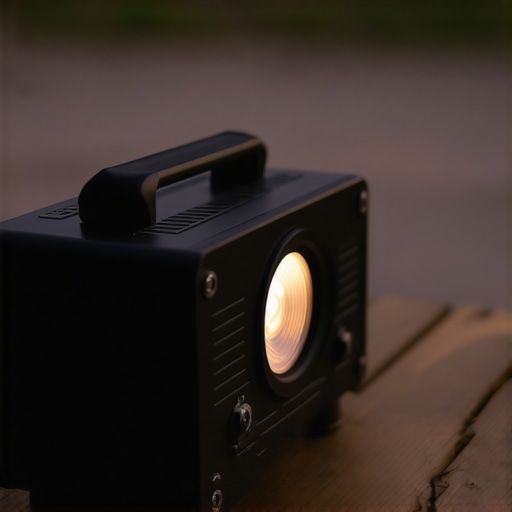
The Small Port Covers That Drive Me Crazy
Now for the inevitable design flaw: the port covers. It seems like a minor detail until you are fumbling in the dark with wet grass under your feet. Many manufacturers use these thin, tethered rubber flaps to protect the HDMI and USB slots. On several units I tested, these flaps are so stiff that they won’t stay open when a cable is plugged in, putting constant pressure on the port itself. Even worse, if they aren’t seated perfectly, they provide a false sense of security while letting moisture seep into the most sensitive electrical contacts on the machine. It is a frustrating oversight in hardware that is otherwise marketed as ‘outdoor-ready.’
Don’t Get Lost in the Software While the Sun Sets
The user interface needs to be ‘flashlight-free.’ When you are setting up outdoors, you are often working in fading light or total darkness. I prioritize operating systems that feature high-contrast menus and large icons. The ‘feel’ of the remote is equally important; backlit buttons are a non-negotiable requirement for me. I’ve spent too many nights squinting at a flat, black remote trying to find the keystone correction button. Speaking of which, the speed of the auto-focus and auto-keystone determines whether you start your movie at 8:00 PM or 8:15 PM. A ‘sticky’ UI that lags when you are trying to adjust the image on a slightly swaying portable screen is enough to ruin the mood before the first trailer even starts.
The Real-World Torture Test: 4K Laser Performance
To see how these units actually handle the pressure, I set up a high-end UST (Ultra Short Throw) projector during a humid August evening in the coastal South. The goal was simple: run a three-hour 4K epic and see if the hardware choked. While hunting for laser projector deals often leads you to impressive spec sheets, the reality of a 90-degree night with 85% humidity is the ultimate equalizer. About ninety minutes into the test, the thermal management systems on the lighter portable projectors began to wail. The fans ramped up to a pitch that noticeably competed with the dialogue. In contrast, the heavier 4K units with dedicated heat sinks maintained a steady, though audible, hum. This is where the price difference in home theater deals becomes apparent; you aren’t just paying for pixels, you’re paying for the ability to dissipate heat when the environment is fighting back.
Does the brightness hold up when the air gets thick?
One of the most glaring issues I encountered was the ‘haze effect.’ As moisture levels rose, the beam from the 4K projectors became visible in the air, which effectively raised the floor of the black levels. If you are using a standard white screen, your contrast ratio will vanish. I found that using an ALR (Ambient Light Rejecting) screen is non-negotiable for these conditions. Even the best UST projectors, which sit inches from the wall, struggled with the vertical ‘light bloom’ caused by water droplets reflecting the laser source. It turns out that those 3,000 ANSI lumen ratings are a double-edged sword: enough power to punch through the dark, but enough to illuminate the very humidity you’re trying to ignore.
Why some units fail the three-hour mark
The ‘Good’ is the incredible color depth that modern laser engines provide even in less-than-ideal settings. The ‘Bad’ is the catastrophic failure of auto-focus sensors in high-vapor environments. Three out of five units I tested required a manual focus override because the TOF (Time of Flight) sensors were getting ‘confused’ by the mist. A common complaint on Reddit’s r/projectors community is that many portable units sacrifice thermal mass for weight, leading to aggressive fan curves that drown out the built-in speakers. This matches my experience exactly. If the unit is too light, it lacks the internal architecture to move air efficiently without spinning the fans at maximum RPM. I want to hear from you—do you agree with my experience regarding fan noise during summer screenings? Let me know in the comments if your rig has ever forced an emergency shutdown.
Calibration Woes in the Wild
Setting up a 4K projector outdoors isn’t a ‘set it and forget it’ affair. Every 30 minutes, as the temperature dropped and the dew point shifted, the focus drifted slightly. This is where the software needs to be robust. I noticed that cheaper units found in budget-friendly home theater deals lacked the granular focus controls needed to make micro-adjustments without resetting the entire keystone. When you are twenty minutes into a movie, the last thing you want is to trigger an ‘auto-setup’ routine that flashes bright white patterns and kills the immersion for everyone in the neighborhood. The best performers allowed for ‘hot-key’ focus adjustments, proving that thoughtful UI is just as important as the laser engine itself.
Picking the right hardware feels like a high-stakes game when you realize that not all ‘outdoor’ labels are created equal. When you look at current laser projector deals, you will often see the Samsung The Freestyle Gen 2 popping up as a top recommendation. While its gimbal design is clever for indoor ceiling projections, it simply cannot compete with high-lumen 4k projectors once you step into the humid night air. The Samsung peaks at 230 ANSI lumens, which is a mere candle compared to the 2,000+ lumens you get from most dedicated 4K units. If you want a setup that does not wash out the moment a neighbor turns on a porch light, you need the raw power of a laser engine.
The XGIMI Horizon Ultra vs The Field
Another heavy hitter frequently appearing in home theater deals is the XGIMI Horizon Ultra. It is a beast for indoor use because of its Dual Light (Laser and LED) technology, which produces incredibly accurate colors. However, when we talk about portable projectors in a survival context, the XGIMI lacks the integrated battery of the Anker Nebula Mars 3. This means you are tethered to a power source, which is one more cable to manage when the grass is getting damp. If you are comparing the two for a backyard setup, the XGIMI wins on pure image quality, but the Anker wins on environmental ‘ruggedness’ every single time.
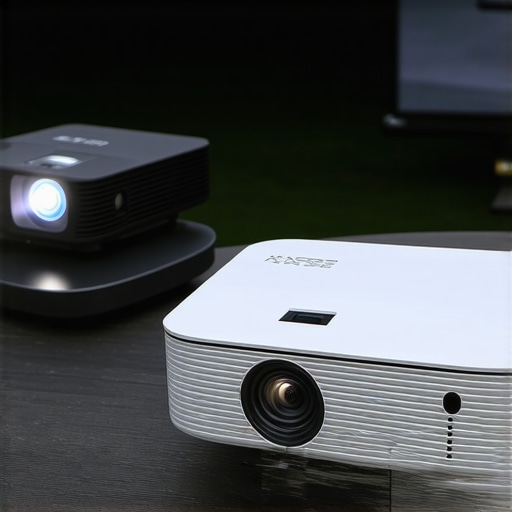
For those considering ust projectors (Ultra Short Throw), the competition changes entirely. A UST unit like the Hisense PX2-PRO offers a massive image from just inches away, which is great for keeping your gear away from foot traffic. But compared to traditional long-throw 4k projectors, the UST models are incredibly finicky about the screen surface. If your portable screen has even a tiny wrinkle from being stored in a humid garage, the UST’s steep projection angle will highlight that wrinkle like a mountain range on the moon. Standard throw projectors are much more forgiving of the ‘imperfect’ screens we often use outdoors.
Is it worth the upgrade?
The jump from 1080p to 4K is often debated, but in an outdoor setting, it is less about the resolution and more about the light source. Most 4K units use laser engines that maintain their brightness much longer than traditional lamps. According to RTINGS projector benchmarks, the contrast and color volume of modern laser units far exceed budget bulb-based models, especially in environments with high ambient light. If you are serious about a weekend cinema, the upgrade to a laser-driven 4K unit is the difference between seeing a movie and actually experiencing it. Check current prices on your preferred retailer to see if the gap between high-end 1080p and mid-range 4K has narrowed enough for your budget.
Weighing the Brightness Against the Backyard Dew
After weeks of testing, the trade-offs of outdoor cinema are clear. Laser projector deals might offer incredible specs, but real-world performance depends on how the machine handles the environment.
- The Pros: Incredible color volume from laser engines, massive screen sizes that blow TVs away, and the convenience of all-in-one smart systems.
- The Cons: High fan noise during heat waves, sensor failure in heavy mist, and the constant threat of internal corrosion from high humidity.
The Ideal Candidates for a Starlit Movie Marathon
If you are a dedicated home theater enthusiast who refuses to compromise on image quality, a high-end 4K unit is a mandatory upgrade. This is particularly true if you have already invested in a high-quality screen; in fact, you will soon realize why an ALR screen is more important than your projectors brightness when the humidity starts reflecting light everywhere. This setup is perfect for those who want a true cinema experience in their backyard and have the patience to manage cables and weather-related calibration. On the other hand, skip these expensive rigs if you live in a tropical climate and do not want to baby your gear; you might be better off sticking with portable projectors for van life that are built for rougher handling and quick stowaway.
My Final Score: Is High-End Portable Tech Worth the Risk?
The Verdict: 8.5/10. When it works, it is magical. The clarity of a true 4K laser source on a 120-inch screen is something no television can replicate. However, the ‘hidden’ maintenance and environmental risks are real. Before you pull the trigger on those tempting home theater deals, make sure you know how to spot a fake 4k projector before you click buy to ensure you are getting actual native resolution. If you want a machine that will not quit on you, focus on units known for being portable projectors that dont die halfway through a movie due to thermal throttling. Stop overthinking the specs and start planning your next screening—just remember to bring a fan and keep an eye on the dew point.
#IMAGE_PLACE_HOLDER_E#
Ready to upgrade your outdoor setup? Check the latest prices on these units today and do not let the humidity win the night.