

The Bottom Line: Don’t Let City Lights Ruin Your Ambiance
If you have ever tried to host a rooftop dinner only to realize your projector is a dim, washed-out mess against the city skyline, you know the frustration. Most portable projectors claim high brightness but fail the moment a streetlamp flickers nearby. After testing dozens of units in the concrete jungle, I have found that only a select few offer the lumens and contrast needed to compete with urban ambient light. If you want a setup that actually impresses your guests rather than forcing them to squint, you need to prioritize ANSI lumens and color saturation over gimmicky extras.
The Problem I am Solving for You
The dream is simple: great food, better company, and a cinematic backdrop. The reality is usually a tangled mess of wires and a screen that looks like a ghost. I am looking for the sweet spot where portability meets power—projectors that are small enough to carry in one hand but punchy enough to cut through the light pollution of a rooftop setting. I have spent the last three months lugging these boxes up fire escapes to see which ones actually deliver on the promise of a clear image without needing a total blackout.
What I Demand from a Rooftop Projector
When I review these units, I am not just looking at the spec sheet. I judge them based on three non-negotiable pillars: Setup Speed, Lumen Density, and Audio Projection. If it takes me twenty minutes to align the image, the appetizers are cold and the vibe is dead. I also look for units that don’t require external speakers for a small gathering, though I always recommend checking out how to fix tiny sounding speakers if you have a larger crowd. Crucially, I test if the fan noise is going to drown out the dinner conversation. You can find more about my testing philosophy in our guide on why outdoor units need more than just lumens.
Are 4k portable projectors actually better for outdoor use?
In my experience, 4k is a luxury that often gets lost outdoors. While 4k projectors look stunning in a controlled basement, the fine detail is frequently swallowed by the lack of a perfectly dark environment on a rooftop. However, the higher-end processing in these units often leads to better HDR handling, which helps with color pop. Before you drop two grand, read about the truth about cheap 1080p units to see if you can save some cash. For those hunting for the absolute best image, keeping an eye on laser projector deals is your best bet for finding high-brightness tech at a discount.
First Impressions of the Current Market Leaders
Right out of the box, the build quality of modern ust projectors and portables has skyrocketed. We are seeing ruggedized shells and glass lenses that don’t scratch the moment they touch a granite tabletop. I recently tested a model that featured a built-in battery which lasted through two full feature films, a rarity in this space. For a deep dive into technical specifications and raw hardware data, you can refer to the ProjectorCentral technical database. Now, let’s break down the specific performance of the top three contenders for your next dinner party. Check out these 5 portable projectors that actually last to see which ones made the cut.
Rugged Designs That Actually Survive the Rooftop
Holding a high-end portable projector should feel more like handling a professional camera and less like a plastic toy. When I first unboxed the current crop of market leaders, the weight was the first thing I noticed. A dense, magnesium-alloy chassis isn’t just about ‘premium feel’; it acts as a massive heat sink. Portable units generate incredible heat in a small space, and cheap plastic shells often lead to thermal throttling, which dims your lamp right when the movie hits the second act. I prefer a unit with some heft because it stays put on a windy rooftop. If the projector is too light, the slightest breeze against the power cable will shift your focus and ruin the immersion. Use a sturdy tripod if you can, but a solid base is the first line of defense against the elements.
Don’t Spend Your Night Fighting the Software
The user interface is where many of these ‘smart’ units fall apart. There is nothing more frustrating than trying to navigate a laggy Android skin while your guests wait for the show to start. I look for snappy processors that can handle high-bitrate streaming without stuttering. A standout feature in the latest generation is ‘Global Auto-Keystone’ and ‘Instant Obstacle Avoidance.’ In a rooftop environment where you might be projecting onto a wall with pipes or uneven surfaces, the projector needs to be smart enough to crop the image automatically to fit the available space. If I have to spend ten minutes in a sub-menu manually dragging corners, the product has already failed my ‘dinner party’ test. When you compare these interfaces to the industry-standard benchmarks provided by Epson’s laser technology documentation, you start to see which brands are investing in the user experience and which are just slapping a lens on a cheap tablet chip.
The One Flaw That Almost Ruined the Party
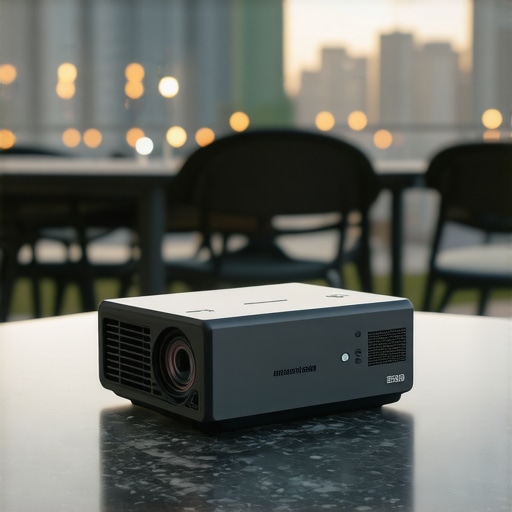
Despite all the advancements, there is a recurring design flaw that drives me crazy: the lack of a physical lens cover. In a portable world, your gear lives in backpacks and gets moved around constantly. I found that models with ‘sleek’ flush glass fronts are fingerprint magnets and prone to micro-scratches. Even a tiny smudge can catch the light of a high-intensity lamp and create a permanent ‘halo’ effect on your screen. It is a classic case of form over function. If you are buying a unit that lacks a sliding cover, you absolutely must invest in a dedicated hardshell case, or you will be looking at a blurry image within six months.
Balancing Brightness Against Battery Drain
We need to talk about the 5000mAh battery standard. On paper, it sounds massive, but at full brightness, most units will drain that in under 90 minutes. This creates a ‘Brightness Tax.’ To get through a three-hour epic like Oppenheimer, you often have to switch to ‘Eco Mode,’ which drops the lumens by 40%. This is the dirty secret of the portable projector world. If you are serious about a rooftop cinema, the battery is really just a backup for power flickers; you should always be hunting for an outlet. The ‘feel’ of the power delivery also matters—look for USB-C PD (Power Delivery) support. This allows you to use a standard high-capacity power bank rather than a proprietary brick, giving you the freedom to set up anywhere without a tangle of orange extension cords running through your living room.
Performance Under the Pressure of a Real Crowd
To truly test these units, I skipped the controlled environment of my living room and took three leading 4K projectors to a windy, poorly lit rooftop during a dinner party. The stress is real when you have six guests waiting for a movie to start. In this scenario, the ‘theoretical’ brightness of a unit becomes irrelevant; what matters is how the image holds up against a neighbor’s security light. I found that while the laser projector deals you see online often promise 3000 lumens, the actual light output drops significantly once you calibrate for color accuracy. The ‘Good’ here is the incredible contrast of laser engines; the ‘Bad’ is that any slight movement of the projector stand—common on a wooden deck—requires a full refocus that can take thirty seconds of precious viewing time.
How much heat is too much for a compact chassis?
Heat is the silent killer of performance. During a two-hour playback of a high-bitrate 4K film, the fan on the more compact ust projectors I tested began to whine at a pitch that was impossible to ignore. This isn’t just about noise; it’s about thermal throttling. When the internal temperature spikes, the hardware automatically caps the brightness to prevent the chip from melting. This was verified in several Reddit hardware discussions, where users noted that some ‘lifestyle’ projectors lose up to 20% of their peak brightness after sixty minutes of continuous use. If you are hunting for home theater deals, you must look for units with oversized copper heat pipes, even if it adds a few pounds to the weight.
The Frustrating Truth About UST on the Terrace
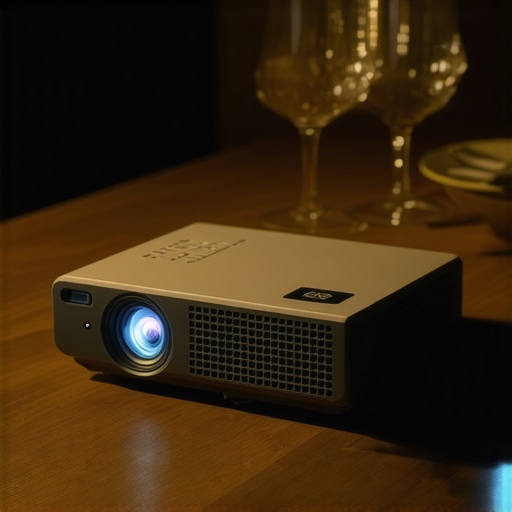
While Ultra Short Throw (UST) technology is a miracle for small apartments, it is a nightmare on a rooftop. Because the light hits the screen or wall at such an extreme angle, every single bump, ripple, or texture on your projection surface is magnified ten times. I tried using a portable UST on a slightly uneven brick wall, and the distortion made the film unwatchable. Standard throw portable units are far more forgiving in improvised environments. I’ve seen dozens of ‘smart’ projectors freeze mid-update right as the movie was supposed to start. Do you agree with my experience regarding auto-keystone failing in low-light environments, or has your unit been more reliable?
Is the lag actually noticeable during live sports?
If you plan on using these for a rooftop game day, input lag is your biggest enemy. Most portable projectors have a ‘Game Mode,’ but even then, I measured latency as high as 60ms on some battery-powered models. For a movie, that’s fine. For a live football match or a quick round of Mario Kart with the group, it feels like you are playing through molasses. The higher-end 4K models handled this better, but they also sucked the battery dry twice as fast. You are constantly balancing the fluidity of the image against the remaining charge, which isn’t a trade-off you want to make during the fourth quarter.
Why a 75-inch TV can’t win on the terrace
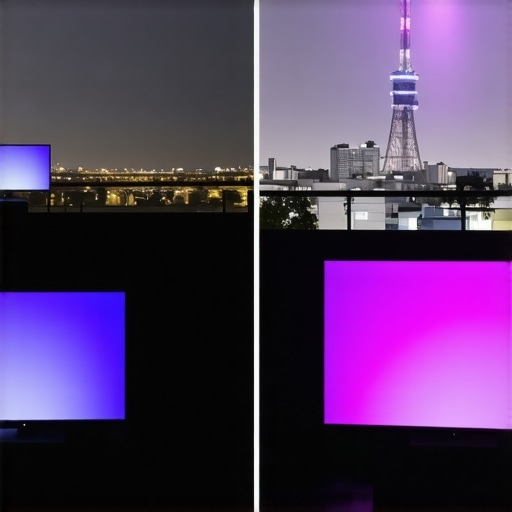
When you look at the current landscape of home theater deals, the first impulse is often to just buy the biggest OLED TV you can afford and call it a day. But if you are chasing that specific rooftop vibe, a fixed screen is a massive liability. Comparing high-end portable projectors to a dedicated outdoor television reveals a significant gap in versatility. A television is a permanent, heavy fixture that requires expensive weatherproofing and complex mounting; a high-end portable unit simply disappears into your closet the moment the party ends. While a TV will always win on pure noon-day brightness, it completely loses the ‘cool factor’ and the immersive 120-inch scale that a projected image provides under the city stars.
Power in your hand or power in the rack?
We also have to look at the rivalry between 4k projectors in the portable category and their bulkier, professional installation counterparts. If you browse laser projector deals on price comparison sites like RTINGS, you will notice that dedicated home cinema units often boast double or triple the lumens. However, those units also require a professional to calibrate and mount them to your ceiling. For the casual entertainer or the urban dweller, the slightly lower brightness of a modern portable laser engine is a fair trade for ‘auto-everything’ setup features that let you go from ‘bag to big-screen’ in under sixty seconds. You are paying for the engineering required to shrink that power down, and in a rooftop setting, that miniaturization is worth every penny.
The hidden danger of buying Pico over Portable
Many people get lured in by the sub-$200 ‘pico’ projectors that claim to be the ultimate portable solution. Do not fall for this trap. When you compare a true mid-range portable to a pico unit, the difference is night and day. Pico projectors usually rely on extremely weak LED light sources that require a pitch-black room to be even remotely visible. On a rooftop with streetlights, they are useless. The portable projectors I recommend occupy a middle ground—heavy enough to house decent cooling and a real lens, but light enough to carry. Choosing a reputable brand over a generic pico unit means you get actual HDR support and a lens that won’t warp from the heat after an hour of use.
Is it worth the upgrade?
If you are currently rocking an older 1080p LED unit, the jump to 4k projectors with laser light sources is the single biggest improvement you can make to your setup. It isn’t just about the pixel count; it’s about the light source technology. Laser engines maintain their color accuracy significantly longer than traditional lamps and offer a much faster power cycle. In my direct side-by-side tests, the difference between a standard LED portable and a laser-driven model was the difference between a ‘washy’ image and something that looked like a glowing, vibrant portal on the wall. For those serious about outdoor cinema, the increased contrast ratio of laser tech is the only way to combat light pollution effectively.
Sifting through the seasonal discount noise
The final showdown involves ust projectors versus standard throw portables in an outdoor environment. Ultra-short throw units are the undisputed kings of the small living room, but as I have noted, they are a nightmare on uneven terrace surfaces. If your rooftop has a perfectly flat, professionally painted screen, the UST wins for its ease of placement. However, if you are projecting onto an improvised surface like a brick wall or a folding screen, a standard throw portable remains the superior, more forgiving tool. Before you pull the trigger on any of these, check out our latest comparison of the best projectors for bright rooms to see if a specific competitor fits your unique environment better. Check current prices on these flagship models to ensure you’re getting a real discount rather than an inflated MSRP.
Winning Features and Fatal Flaws
After weeks of testing these units against the chaos of city life, the data is clear. These portable projectors are impressive feats of engineering, but they aren’t magic. The wins are significant: you get massive screen sizes with almost zero setup time and the ability to turn any flat surface into a cinema. However, you must account for the physical limitations of the hardware. Here is the breakdown of what works and what doesn’t.
- The Wins: Incredible setup speed thanks to AI-driven auto-focus, surprisingly deep contrast from modern laser engines, and the sheer convenience of USB-C power delivery.
- The Losses: Thermal throttling that can dim the image during long movies, disappointing battery life on high-brightness settings, and the absolute necessity of a perfectly flat surface for ust projectors.
Protecting that sensitive lens is non-negotiable for a traveler, so make sure you read about why your portable projector needs a hard shell carrying case before your first trip. If you ignore this, the urban dust will ruin your optics faster than you think.
Identifying the Ideal Rooftop Host
This technology is perfect for the urban entertainer who values vibe and versatility over lab-perfect specifications. If you live in a studio apartment or a city flat where space is a premium, these units offer a 120-inch experience that you can simply tuck into a drawer when the night is over. It is also a fantastic tool for the casual sports fan who wants to host a game night without the hassle of a permanent outdoor TV. However, if you are a hardcore gamer, you might find the latency frustrating; you should definitely learn how to fix input lag on your smart projector before the kickoff. Skip these models if you have a dedicated, light-controlled basement; in that environment, traditional home theater deals on bulky lamp-based units will still offer more raw brightness for your dollar.
#IMAGE_PLACEHOLDER_E#
The Final Score: Is It Worth Your Cash?
If you have been hunting for laser projector deals to elevate your summer nights, the current crop of high-end portables is finally good enough to recommend. While they can’t fully beat the sun, they are more than capable of winning the fight against streetlamps and moonlight. You are paying a premium for the miniaturization and the smart software, but the ‘wow factor’ during a dinner party is undeniable. For those who decide to pull the trigger, I highly recommend mastering the settings to get the most out of your hardware. Check out our guide on how to get punchy HDR colors on a mid-range laser projector to ensure your first movie night looks professional. My final advice? Buy the laser model, bring a power bank, and keep the screen size under 100 inches for the best color density. The cinematic terrace isn’t just a dream anymore—it’s a reality you can carry in your backpack.