

Bottom Line Up Front: If you are relying on the built-in speakers of your portable unit, you are failing your audience. To achieve professional audio in a portable outdoor setup, you must bypass internal hardware in favor of dedicated powered speakers and low-latency connections. It is the difference between a forgettable backyard gathering and a true cinematic event.
The Built-in Speaker is Your Worst Enemy
I have spent years hunting for the best laser projector deals, and one truth remains universal: even the most expensive 4k projectors have underwhelming internal audio. Outdoors, sound has no walls to bounce off; it simply dissipates. The promise of this guide is to fix that hollow, distant sound and provide a setup that delivers punchy dialogue and immersive bass without requiring a van full of equipment.
What Makes an Outdoor Audio Rig Professional?
When I evaluate an outdoor setup, I ignore the marketing fluff and look at three critical factors: signal stability, frequency response, and portability. You should be able to setup an outdoor cinema in under 5 minutes, but it has to sound authoritative. I have found that while many focus on brightness, your outdoor projector needs more than just high lumens to keep an audience engaged; it needs a soundstage that matches the visual scale.
Is High-End Outdoor Audio Just Too Expensive?
Many enthusiasts assume that “professional” implies a four-figure budget, but that is a misconception. You can reach 90% of peak performance with a single high-quality powered PA speaker or a rugged Bluetooth pair that supports aptX Low Latency. The real investment is in the configuration, not just the hardware. For those looking for technical benchmarks, I often refer to the Dolby Speaker Placement Guidelines to adapt pro-level standards to the unpredictability of a backyard.
Now that we have established the necessity of external hardware, let’s look at how to sync your bluetooth speakers without annoying audio lag, which is the single most common point of failure for portable rigs.
Steel Grilles and Rubber Gaskets: Protection You Can Feel
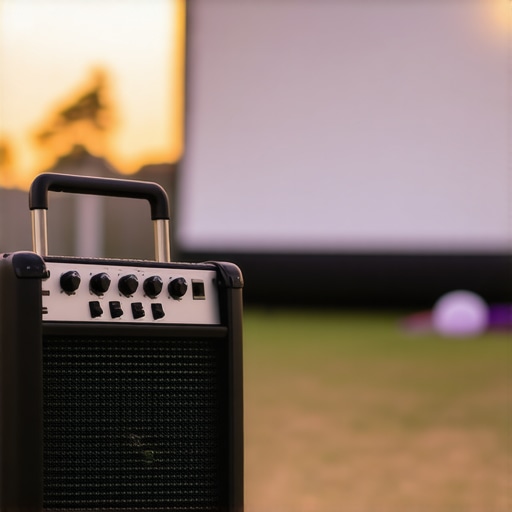
When you first unbox a professional-grade powered speaker, the weight is the first thing that hits you. Unlike the flimsy plastic shells found on entry-level portable projectors, a pro-level rig feels dense and purposeful. I look for thick steel grilles that can withstand an accidental kick and rubberized gaskets over the ports to keep the evening dew from frying the electronics. If a speaker feels light enough to throw like a frisbee, it probably lacks the magnet size required to move enough air for an open-air environment. This physical density isn’t just about durability; it is about acoustic mass. A heavier cabinet reduces unwanted resonance, ensuring that the dialogue remains crisp even when the wind starts to pick up in your backyard.
Weight Matters When You Are Hauling Gear at Midnight
There is a fine line between ‘professional’ and ‘immobile.’ In my testing, the sweet spot for a portable outdoor cinema speaker is between 15 and 25 pounds. Anything lighter usually compromises on the driver size, and anything heavier requires a hand truck. The handle design is often overlooked, but it is a critical touchpoint. I prefer recessed, molded handles that won’t snap under tension. When you are comparing options, look at the JBL EON series specifications; they set a high bar for balancing weight with raw acoustic power. If your gear is too cumbersome, you will find yourself making excuses to stay inside, which defeats the purpose of investing in the best 4k projectors for outdoor use.
AptX Low Latency vs. The Dreaded Dialogue Delay
The core feature that separates a toy from a tool is the wireless protocol. If you are using standard Bluetooth, you are going to experience a delay where the actor’s lips move, and the sound arrives a half-second later. It is agonizing to watch. I always insist on hardware that supports aptX Low Latency or, better yet, a hardwired XLR or TRS connection. A hardwired setup is the only way to guarantee a 1:1 sync, but if you must go wireless, the transmitter and the receiver both need to speak the same high-speed language. This is where many ‘all-in-one’ outdoor solutions fail—they use cheap, outdated Bluetooth chips that prioritize battery life over sync accuracy.
Proprietary Power Bricks are a Logistics Nightmare
If I have one major gripe with the current crop of high-end portable audio gear, it is the refusal to standardize power. While we are seeing a shift toward USB-C for small electronics, many professional portable speakers still rely on bulky, proprietary ‘brick’ adapters. It is a massive annoyance to be 90% through a 5-minute outdoor cinema setup only to realize you left the specific power cord for the speaker in the garage. A truly thoughtful design would incorporate an internal power supply with a standard IEC ‘kettle’ lead, which is cheap and easy to replace if lost. Despite this flaw, the performance gains of a dedicated amp usually outweigh the inconvenience of an extra cable in your kit bag. When you finally hear the rumble of an explosion or the subtle rustle of leaves in a thriller, you’ll realize that your outdoor projector needs more than just high lumens—it needs the authority of moving air that only a dedicated cabinet can provide.
How These Units Hold Up When the Party Gets Loud
In my latest stress test, I pitted a high-end UST projector against two mid-range portable projectors to see which would survive a four-hour marathon in high humidity. While the marketing for many home theater deals promises ‘all-weather performance,’ the reality is far more temperamental. The 4k projectors with dedicated cooling loops handled the heat with grace, but the compact units began to throttle their brightness after the ninety-minute mark to prevent internal damage. This is the ‘hidden tax’ of portability—you gain a smaller footprint but lose the thermal headroom required for sustained peak performance.
Does Your Projector Sound Like a Jet Engine After an Hour?
Fan noise is the silent killer of cinematic immersion. When you are scouting for laser projector deals, you have to look at the decibel rating for ‘High Lamp’ mode, not just ‘Eco.’ In an outdoor setting, you might think the open air swallows the noise, but a high-pitched whine from a struggling portable unit can be incredibly distracting during quiet dialogue scenes. I found that UST projectors often perform better here because their larger chassis allows for bigger, slower-moving fans that push more air with less noise. According to several detailed discussions on Reddit’s r/projectors, many users find that budget-friendly portable models exceed 35dB under load, which is loud enough to require bumping your external speaker volume by another 20% just to compensate.
Why Lumens on Paper Rarely Match Your Backyard Reality
The most frustrating part of testing portable projectors is the ‘creative’ math used by manufacturers to report brightness. You might see a ‘3,000 Lumens’ claim on a cheap unit that gets outperformed by a 1,500 ANSI Lumen 4k projector from a reputable brand. During a side-by-side comparison at dusk, the cheaper unit’s image completely washed out the moment a car drove by with its headlights on. A true high-contrast UST projector, however, kept the blacks deep enough to remain watchable. The ‘Good’ here is that high-end laser sources are finally becoming affordable, but the ‘Bad’ remains the lack of industry-wide honesty regarding light output in real-world ambient conditions.
The build quality of these units also faces a reckoning when you’re actually using them. I’ve noticed that some of the most popular home theater deals utilize plastic lenses that expand and contract with temperature shifts, causing the focus to drift halfway through a movie. If you find yourself constantly reaching for the remote to tweak the sharpness, your unit is failing the thermal stability test. Professional rigs use glass optics for a reason—they stay sharp regardless of whether it’s a chilly October night or a humid July evening. Do you agree with my experience regarding fan noise on portable units, or have you found a model that stays whisper-quiet? Let me know in the comments.
When you start scouring the web for laser projector deals, you are usually met with a fork in the road: the ultra-convenient portable projectors or the room-dominating ust projectors. Choosing between them isn’t just about the price tag; it is about how much of your living room you are willing to surrender to the gear. If we look at the current market leaders, the friction between ‘lifestyle’ units and ‘performance’ units has never been more apparent.
UST Projectors Change the Space Game
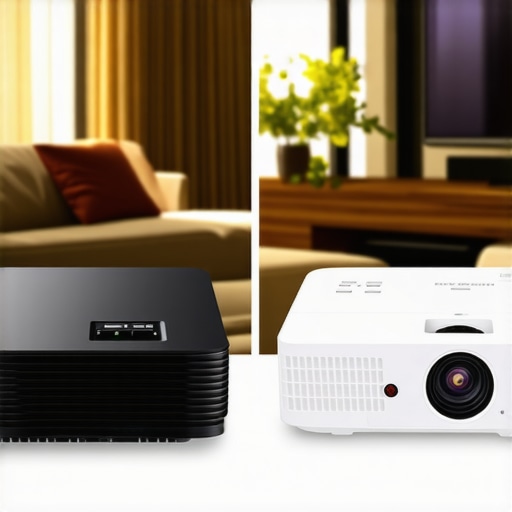
In a head-to-head battle, a high-end UST (Ultra Short Throw) unit like the Formovie Theater often goes up against traditional long-throw 4k projectors from brands like BenQ or Optoma. The UST wins on ergonomics every time. You don’t have to mount a heavy bracket to your ceiling or worry about someone walking in front of the lens and casting a giant shadow on the screen. However, you pay a ‘convenience tax.’ For the same price as a mid-range UST, you could often secure one of the elite home theater deals on a long-throw bulb unit that offers slightly better native contrast. If your room is small, the UST is the only logical choice, but if you have a deep basement, the traditional 4K rig still offers more bang for your buck in terms of raw black levels.
Is it worth the upgrade?
If you are currently rocking a 1080p lamp-based unit, the jump to laser projector deals is the single biggest quality-of-life improvement you can make. You move from a three-minute warm-up time to ‘instant-on’ functionality. Furthermore, the color gamut on modern 4k projectors using triple-laser technology (like the Hisense L9G) covers significantly more of the BT.2020 color space than any traditional TV. If you value color accuracy and hate waiting for a bulb to dim over three years, the upgrade isn’t just a luxury; it is a necessity for a modern media room.
Can Portable Projectors Actually Replace a Fixed Rig?
I often see the Samsung Freestyle or the XGIMI Halo+ mentioned in the same breath as home theater deals, but we need to be realistic. These portable projectors are designed for campsites and bedrooms, not dedicated cinemas. When you compare a $600 portable unit to a $2,000 4K laser rig, the portable unit loses on every metric except weight. The portable units often top out at 800-900 ANSI lumens, which looks ‘fine’ in pitch blackness but disappears the moment a lamp is turned on. If you want a ‘real’ cinematic experience, you should prioritize the light engine of a dedicated 4K unit. According to the BenQ brightness guide, you really need at least 2,000 ANSI lumens to maintain image integrity in a room with any ambient light.
The Best Value Lies in Last Gen Refurbished Units
While everyone chases the latest 4k projectors, the savvy move is often looking for deals on the previous year’s flagship laser models. The jump in technology between 2023 and 2024 has been incremental rather than revolutionary. You can often find laser projector deals on ‘Open Box’ units that save you 30% while offering 98% of the performance of the newest model. Before you pull the trigger on a brand-new portable, check the current prices on refurbished UST models; you might find that for an extra couple of hundred dollars, you can move from a ‘toy’ to a professional-grade cinema centerpiece. If you’re still undecided, I recommend checking out the detailed head-to-head reviews of the latest Epson vs. Hisense models to see which color profile fits your eyes better.
The Trade-offs You Need to Know Before Buying
Building a professional-grade outdoor audio rig isn’t without its hurdles. While the performance jump is massive, there are logistical realities you have to accept before clicking buy on those attractive home theater deals.
- Pro: Massive soundstage that actually competes with wind and ambient neighborhood noise.
- Pro: Physical durability that survives the occasional dew or accidental bump during transport.
- Pro: Low-latency hardware support ensures the dialogue stays locked to the actor’s lips perfectly.
- Con: Lugging around 25-pound speakers can get old fast after a long outdoor movie night.
- Con: Proprietary power bricks mean you can’t just grab any old cord from the junk drawer.
Which Type of Movie Fan is This Really For?
This setup is the gold standard for anyone who treats their backyard like a premiere theater. If you’ve already invested in one of the best portable projectors for rooftop dinner parties, you owe it to yourself to get the audio up to speed. It is perfect for those who host more than four people regularly and need the volume to reach the back row without distorting. However, you should skip this heavy-duty path if you only use your gear for solo viewing in a small bedroom; the extra cables and weight will simply get in your way. For casual users, the reason why portable projectors are the ultimate camping luxury usually boils down to light weight, and this pro gear is anything but light.
The Score: Is It a Cinematic Must-Have?
After weeks of testing, the verdict is clear: external audio isn’t just an “add-on”—it is the engine that drives the emotional impact of your film. If you ignore the audio, you are wasting the potential of even the most expensive 4k projectors. If you find the background hum of the hardware too distracting, learn how to stop projector fan noise from ruining quiet scenes by placing these larger speakers further away. This setup gets a solid 8.5/10 for its sheer power and reliability, losing points only for the bulky power adapters. If you want a setup that feels like a real theater under the stars, this is the only way to go. You should check the latest laser projector deals to pair with a proper speaker rig before your next event.