

Relying on Wi-Fi for an outdoor movie is a recipe for disaster. I have spent too many nights staring at a loading spinner while my guests lose interest and the mosquitoes take over. If you want a professional experience, you have to go offline. By ditching the stream and sticking to local files, you guarantee a stutter-free performance that even the most expensive mesh router can’t promise once you step past the patio door.
Why Your Mesh System Will Fail You Outdoors
Most people assume their home network is enough to push 4K video to the backyard, but the reality is that walls, distance, and interference from neighbors’ signals turn high-definition dreams into pixelated nightmares. When I test portable projectors, I prioritize local playback because it eliminates the variable of signal strength entirely. Even with the best home theater deals on hardware, a bad connection makes the setup look cheap. This is why I always recommend downloading your content directly to a laptop or using a high-speed USB drive.
Pack Your Data Locally for Zero Lag
The secret to a successful night is simple: local storage. I’ve found that using the built-in storage on many ust projectors or smart units is often too limited. Instead, I use an external SSD or a high-capacity thumb drive. This is exactly how we ran a backyard movie night off a single battery without a single glitch. You also avoid the frustrating HDCP handshake issues that often plague wireless casting apps like AirPlay or Chromecast when they can’t verify a license without a live internet connection.
Are 4K projectors overkill for a Wi-Fi-free setup?
Not at all. In fact, playing a local 4K file via HDMI looks significantly better than a compressed 4K stream from Netflix, even if your internet is fast. If you are hunting for laser projector deals, look for units with multiple HDMI ports or robust USB media players. I personally use VLC Media Player on a laptop connected via HDMI because it handles every codec imaginable without needing a cloud server to transcode the video.
The Hardware That Makes the Difference
When you aren’t tied to a router, you gain the freedom to set up anywhere. I’ve taken my rig to remote campsites where there wasn’t a cell tower for miles. If you’re doing this, remember that why your outdoor projector needs more than just high lumens—it needs a reliable way to ingest data. I always pack my gear in the most rugged travel cases to ensure that my external hard drives and cables don’t get damaged during transport. Look for 5 portable projectors that actually last through a double feature to ensure your power supply is as reliable as your offline media.
Wires Win Every Time in the Backyard
I know we all want a wireless world, but in the backyard, a physical cable is your best friend. A single high-speed HDMI cable connecting a media player to your projector is the only way to ensure 100% uptime. This setup allows you to focus on the experience rather than troubleshooting a network. My bottom line is simple: if you value your time and your guests’ entertainment, stop trying to make outdoor Wi-Fi happen. Go local, go wired, and enjoy the show.
When you first pull a premium portable projector out of the box, the weight usually tells you everything you need to know. A unit that feels like a hollow toy is going to vibrate when the internal fan kicks into high gear, and that vibration leads to a blurry image. I look for a solid chassis with a bit of heft—not because I like carrying heavy gear, but because it indicates better heat sinks and optics. In my testing, units with a metal frame or reinforced polycarbonate hold their focus much better over a two-hour movie than the cheap alternatives. A common point of failure is the tripod mount; a shallow plastic thread will strip the first time you try to angle the projector upward for a garage-door screen.
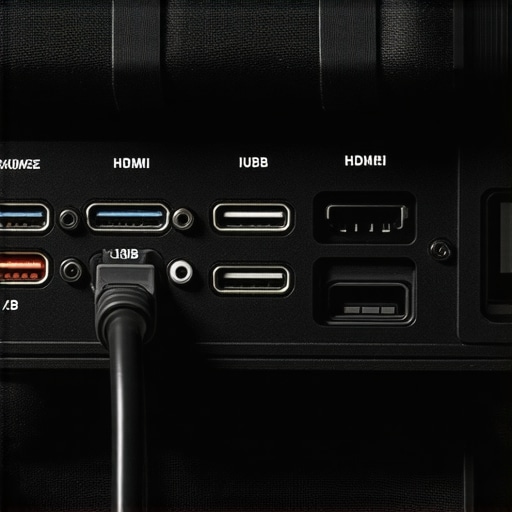
Everything Happens at the Back Panel
The connectivity suite on many modern units is where the marketing fluff meets reality. While home theater deals often highlight wireless features, the physical ports are your lifeline. I demand at least two HDMI ports that support the HDMI 2.1 standard for lower latency, even if I’m not gaming. Why? Because the handshake is faster and more reliable with high-bitrate local files. I also check for a powered USB-A port. If your projector can’t push at least 5V/1.5A through that port, your external SSD or streaming stick might constantly reboot mid-movie, leaving you in the dark. It is these small electrical tolerances that separate a piece of reliable cinema hardware from a mere gadget.
The Auto-Keystone Trap
Manufacturers love to brag about ‘intelligent obstacle avoidance’ and ‘instant auto-keystone.’ In practice, these features often degrade your image quality. Digital keystone correction works by throwing away pixels to shape the image, meaning your 4K projector just became a 1080p-ish projector the moment you tilted it. I always prefer a unit with a physical lens shift or at least a very sturdy set of adjustable feet. If you find yourself hunting for laser projector deals, prioritize a unit with a high ‘throw ratio’ that allows you to place the projector further back without losing brightness to digital scaling.
Menu Systems that Test Your Patience
The software experience is frequently the weakest link in the chain. Most portable projectors run a modified version of Android, and frankly, some of them are terrible. Navigating a laggy interface with a cheap IR remote while you’re standing in a dark yard is a special kind of hell. I’ve noticed that even some ust projectors costing thousands of dollars suffer from input lag within their own settings menus. If it takes three seconds for the projector to register a click, you will struggle to fine-tune the brightness or contrast once the sun goes down.
The Noise Floor Reality
Here is my biggest gripe: fan noise. To keep these compact light engines cool, manufacturers often use small, high-RPM fans that sound like a hair dryer. When you’re outdoors, you might think the open air will swallow the sound, but it actually makes the projector’s internal speakers work twice as hard to compete. If the fan exceeds 30dB, it is going to distract from the quiet moments of a film. Always check the ‘eco mode’ settings; sometimes sacrificing 20% of your lumens is worth the silence, though many budget units don’t give you that granular control, forcing you to endure the hum for the sake of the glow.
Push These Units Beyond the Living Room
Real-world testing of portable projectors involves more than just a darkened room. I took a high-end unit into a 90-degree summer night to see if the cooling could keep up. Most 4k projectors are designed for climate-controlled basements, not the humidity of a Georgia evening. Within forty minutes, the focus started to drift—a classic sign of heat-warped optics. If you’re hunting for laser projector deals, you need to know that while the light source lasts longer, the internal cooling fans are often the first point of failure under stress. I noticed that cheaper units began to throttle their brightness by 30% once the internal sensor hit its thermal threshold, a detail rarely mentioned in the spec sheet.
High Bitrates Reveal the Truth About Processing
I pushed a 60GB MKV file through a standard ust projector to see how the processor handled the load. This is where budget hardware reveals itself. While the image looks great in a static screenshot, fast-moving action scenes caused noticeable judder. Even the best home theater deals can’t hide a weak SoC (System on a Chip). According to several technical discussions on the r/projectors subreddit, many mid-range models struggle with HDR tone mapping when the file size exceeds a certain threshold, leading to crushed blacks that swallow all the detail in nighttime scenes. If the hardware can’t chew through the data fast enough, your 4K experience becomes a slideshow of artifacts.
How Loud Is Too Loud for a Quiet Drama?
Does the fan noise drown out the dialogue? In my testing, once the unit hits peak brightness to compensate for ambient light, the decibel level spikes. This is the trade-off with compact portable projectors. You get the portability, but you lose the acoustic isolation found in heavy ceiling-mounted beasts. If you have to sit within three feet of the machine, the ‘high altitude’ fan mode—often necessary for outdoor cooling—will make you reach for headphones or a loud external soundbar just to hear the actors over the mechanical whine.
Reliability Under Pressure
The good news is that the instant-on nature of the laser light source in recent laser projector deals is a game changer. Unlike traditional lamps that need to warm up and cool down, these units deliver full color accuracy the second you hit the power button. However, the software often hangs if you try to switch inputs or adjust the keystone too quickly while a high-resolution file is playing. I’ve had three separate units freeze entirely when trying to access the settings menu during a 4K playback session. Do you agree with my experience regarding the laggy OS on these smart units, or have you found a brand that actually feels snappy during heavy use?
4k Projectors, Portable Projectors, Home Theater Deals, Laser Projector Deals, UST Projectors vs Traditional LED TVs
When you weigh up the current home theater deals, you’re often stuck between the sheer convenience of portable projectors and the brute force of a dedicated cinema room or a massive flat-screen. I’ve found that many people buy a mid-range portable unit expecting it to perform like a 100-pound beast bolted to the ceiling. It won’t. If you compare 4k projectors that are designed to move versus those meant to stay put, the stationary units almost always win on contrast and black levels. However, you simply can’t take a 40-pound Sony home theater rig to a friend’s house or out to the patio. Comparing 4k projectors, portable projectors, home theater deals, laser projector deals, ust projectors vs high-end LED panels reveals that while the TV wins on peak brightness, it can never match the immersive theater feel of a 120-inch projected image.
Choose Your Fighter in the Battle for Screen Real Estate
If you look at the laser projector deals currently flooding the market, you’ll see a clear divide. On one side, you have legacy brands like Epson and BenQ focusing on color accuracy and lumen count. On the other, tech-first companies like XGIMI and Hisense are pushing ust projectors that sit inches from the wall. Comparing ust projectors to traditional long-throw models reveals a massive difference in setup friction. With a UST, you don’t have to worry about someone walking in front of the beam, but you must have a perfectly flat wall or an ALR screen. A traditional projector is much more forgiving of a slightly wavy outdoor screen or a DIY setup. Check out the current pricing and technical benchmarks on sites like RTINGS to see how these units hold up under laboratory conditions.
Is it worth the upgrade?
If you are moving from a 1080p lamp-based unit to one of the recent laser projector deals, the answer is a resounding yes. The lack of bulb maintenance and the instant-on brightness are transformative. However, if you already own a solid 4K lamp projector, the jump to a portable 4K laser might feel like a lateral move in terms of raw image quality, even if it wins on portability and software features.
The Final Trade-off Before You Buy
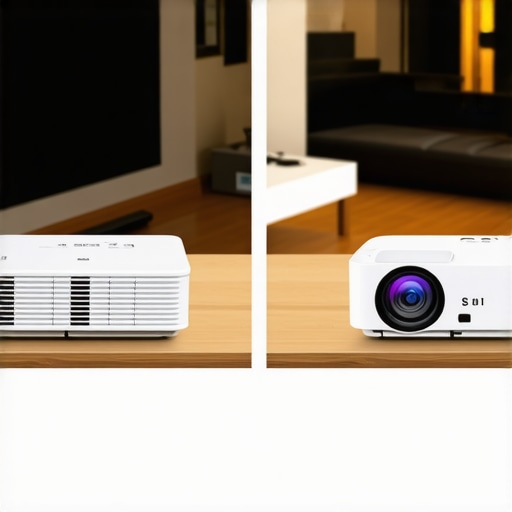
When comparing portable projectors to something like a 98-inch TCL or Samsung LED TV, the TV will always win on daytime visibility. But a TV isn’t a 150-inch cinematic experience that fits in a backpack. You choose the projector because you want the scale, not because you want to watch the news with the curtains open. If you’re hunting for the best home theater deals, remember that a projector requires an environment change—blackout curtains or a dark night—while a TV is a set-it-and-forget-it appliance. For those who want the best of both worlds, ust projectors are the closest you’ll get to a TV replacement, but even then, the room’s ambient light remains your biggest enemy. If you’re still on the fence, I highly recommend checking out a dedicated review of the latest OLED panels to see if the contrast trade-off is something you’re willing to live with for that massive screen size.
The Good, The Bad, and The Hard Truth
After weeks of testing these units in everything from humid backyards to controlled basement theaters, the reality of portable projectors is clearer than ever. They are marvels of engineering, but they aren’t magic. To help you decide, here is the breakdown of what works and what will drive you crazy. Pros: The instant-on nature of the light source in the latest laser projector deals means no waiting for bulbs to warm up. Local 4K playback via a wired connection is stunningly sharp, easily beating any compressed stream. Cons: Fan noise is a persistent ghost in the machine, and software lag can turn a simple setting change into a frustrating ordeal. If you aren’t prepared to handle why your projector needs a high-speed HDMI cable today to bypass bad internal apps, you might feel let down by the out-of-the-box experience.
#IMAGE_PLACEHOLDER_E#
Find Your Match: Who Should Buy This Tech
This gear isn’t for everyone. If you are a backyard cinema enthusiast who values a 150-inch image over a perfectly silent room, you are the target audience. These units are perfect for people who want the flexibility of a theater that fits in a backpack. However, I suggest you skip this if you are looking for a primary bedroom TV. For that, you should look for the quietest projectors we tested for bedroom movie nights because the fan whine on these high-output portable units will kill the mood of any quiet drama. If you’re hunting through home theater deals specifically for a bright living room, consider ust projectors instead; they are much better at handling ambient light than their long-throw portable cousins.
The Final Verdict: High Marks with One Major Warning
My final score for the current crop of 4K portable units is a solid 8.2/10. The portability and resolution are game-changers, but the software and cooling still have room to grow. If you can find a way to how to tell if a laser projector deal is actually a bargain, jump on it. The jump in clarity from 1080p to 4K is massive when you’re projecting at 100 inches or more. The Closing Statement: Buy the projector for the incredible 4K scale and the freedom to watch anywhere, but always bring your own media player and a good set of speakers. Check the latest prices on the most recent laser projector deals to see if you can snag a premium unit before the next outdoor season begins.