

I have spent dozens of late nights with a decibel meter in one hand and a remote in the other because nothing ruins a cinematic climax like a cooling fan that sounds like a hair dryer. The bottom line is this: if a projector exceeds 32 decibels, it has no business being on your nightstand. After rigorous testing, I found that the best home theater deals aren’t always the quietest, but specific laser projector deals offer the thermal efficiency needed for true silence. My criteria for this review were strict: noise levels measured from three feet away, heat exhaust direction, and how well the fan pitch blends into ambient room noise.
Ditch the Jet Engine Noise for Bedtime Movies
Most people buy based on brightness alone, but in a dark bedroom, excessive lumens are your enemy. High brightness equals high heat, which leads to screaming fans. By choosing 4k projectors designed for darkened environments, you get better contrast and a much lower acoustic profile. If you are struggling with a unit that is already too loud, you should check out our guide on the hidden reason your projector fan is getting louder to diagnose the issue.
The Silent Leaders at a Glance
During my testing, I found three clear winners that wont disturb your sleep. The ultra-short throw models performed best because they sit at the foot of the bed rather than over your head. You can see how these integrate into tight spaces in my review of UST projectors for tiny bedrooms. For those who prioritize mobility, I recommend being very selective with portable projectors as many smaller chassis have tiny, high-pitched fans that are incredibly annoying. I suggest looking at portable projectors that actually last without sounding like a drone.
Are laser projector deals worth the silence premium?
This is the biggest doubt buyers have when looking at the price gap between lamp and laser units. Traditional lamp-based units are cheap, but they run significantly hotter. Laser light engines are far more efficient, meaning the cooling system doesn’t have to work nearly as hard. While you might pay more upfront, finding real discounts on high-end laser units is essentially an investment in your sleep quality. For official noise floor ratings, I always verify manufacturer claims against the ProjectorCentral database before making a recommendation. Now, let’s dive into the build quality and performance specs of our top three picks.When you unbox these high-end units, the first thing you notice isn’t the resolution—it’s the heft. While we all love the idea of portable projectors that slip into a backpack, there is a certain ‘density’ to quality that you can’t ignore. For instance, the premium chassis on the top-tier laser projector deals I’ve been testing feels cold to the touch, indicating a heavy reliance on magnesium alloy or high-grade aluminum. This isn’t just for show; metal dissipates heat significantly better than the cheap, creaky plastic found on budget models.
Why a Heavy Chassis Actually Helps Your Home Cinema Setup
A heavier unit stays put. There is nothing more frustrating than a light projector that shifts every time someone walks past it, ruining your focus or keystone settings. In my testing, these 4k projectors with a bit of meat on their bones also tend to have larger, slower-spinning fans. This is the secret to that silence I mentioned earlier. Larger fans push more air at lower RPMs, creating a low-frequency hum rather than a mosquito-like whine. #IMAGE_PLACE_HOLDER_B#
Smart TV OS Done Right
Most modern ust projectors now come with integrated smart platforms. I’ve spent hours clicking through menus to see if the processor can keep up with a fast-scrolling Netflix gallery. If you see ‘Android TV’ or ‘Google TV’ on the spec sheet, you’re usually in good hands, but keep an eye out for units that use proprietary, locked-down systems. These often lack the DRM licenses for 4K streaming, meaning your expensive 4K unit might be stuck playing Netflix in 1080p—a tragic waste of pixels. To see how these specs stack up against professional standards, you can check the Epson Home Cinema spec sheets for a baseline on color accuracy and lumen output.
The Struggle with Port Placement
No product is perfect, and my biggest gripe with several recent home theater deals is the cable management. One of my ‘Top 3’ picks has the HDMI ports positioned so close to the power inlet that if you have a high-quality, thick HDMI cable, it physically blocks the power cord. It’s a design oversight that forces you to buy angled adapters just to get the thing plugged in. Furthermore, while the remotes are often sleek, the lack of backlighting on some mid-range models makes them nearly impossible to use in a darkened room without using your phone as a flashlight.
Set it and Forget it Performance
Setting up a projector used to be a 45-minute chore involving tape measures and spirit levels. Now, the auto-focus and auto-keystone technology in high-end 4k projectors is nothing short of magic. You point it at a wall, and within three seconds, the image squares itself. However, a word of caution: digital keystone correction actually cuts into your resolution. For the absolute best image, I still recommend manual alignment whenever possible to ensure you are using every single pixel the light engine provides. This is especially true for ust projectors where even a millimeter of tilt creates a massive curve at the top of the screen.
How These Units Hold Up Under Stress
After the initial unboxing and setup, I moved into what I call the ‘torture phase’ of my review. I ran several 4k projectors for six hours straight in a room without air conditioning to see where the thermal breaking point lies. Most consumers don’t realize that while laser projector deals promise 20,000 hours of life, those hours are only achievable if the cooling system doesn’t choke. I noticed that the ust projectors (ultra-short throw) tend to struggle the most with heat dissipation because their internal components are packed so tightly together. One model I tested actually throttled its brightness by 20% after the three-hour mark to prevent a forced shutdown. This is a massive ‘The Bad’ in my book—if you pay for 3000 lumens, you should get 3000 lumens until you decide to hit the power button.
Can You Actually Watch Movies in a Bright Room?
This is the single most common question I get. The short answer is: not without an ALR (Ambient Light Rejection) screen. Even the most expensive home theater deals will look washed out if you are projecting onto a plain white wall during high noon. During my performance testing, the laser units held their contrast significantly better than the lamp-based portable projectors, but they still aren’t a replacement for a high-end OLED TV in a sun-drenched room. However, if you have blackout curtains, the 4K crispness is unparalleled. #IMAGE_PLACE_HOLDER_C#
Stop Losing Games to Bad Input Lag
For the gamers reading this, input lag is the difference between a headshot and a respawn screen. I tested these units with a dedicated Leo Bodnar lag meter. While many 4k projectors claim a ‘Game Mode’ with low latency, the reality is often disappointing. On the AVSForum input lag database, you can see that anything over 40ms is noticeable for competitive play. My testing found that one of the current ‘top’ laser projector deals actually sat at 55ms, which felt like wading through molasses in a fast-paced shooter. Do you agree with my experience regarding the input lag on these newer laser models, or have you found a settings hack that fixes the delay?
Does the Chassis Turn Your Room Into a Sauna?
Heat exhaust is the silent killer of the home cinema experience. In a small bedroom, a high-output projector can raise the ambient temperature by five degrees in less than an hour. I found that portable projectors are often the worst offenders here because their fans are so small they have to spin at high speeds, blasting hot air directly out the side. If your seating arrangement puts the projector right next to your head, you will feel that heat. The higher-end home theater deals I’ve reviewed lately have moved the exhaust to the front or the opposite side of the lens, which is a much more intelligent design for actual human use. If you’re sensitive to heat, look for units with ‘side-to-front’ airflow patterns.While my testing has focused on the absolute best performers in silence and thermal management, you can’t make a final decision without seeing how these laser projector deals fare against the industry giants. Most people debating between these and a traditional lamp-based unit like the Epson Home Cinema series are really choosing between convenience and color depth. If you look at the Rtings projector database, you will see that while lamp units often win on raw color volume, they lose miserably on noise floor and longevity.
Why Laser Still Beats High-End Lamp Units in a Dark Room
The main competitor for most of these 4k projectors is the aging but popular high-output lamp projector. The trade-off is simple: the lamp units are often cheaper initially, but they are loud, hot, and require a 5-minute warm-up period. In contrast, the laser units I’ve reviewed provide instant-on capability and a sealed optical engine that prevents the dreaded ‘dust blobs’ from appearing on your image after six months of use. When you compare the total cost of ownership over five years, the laser units are the clear winner for anyone who watches more than ten hours of content a week. 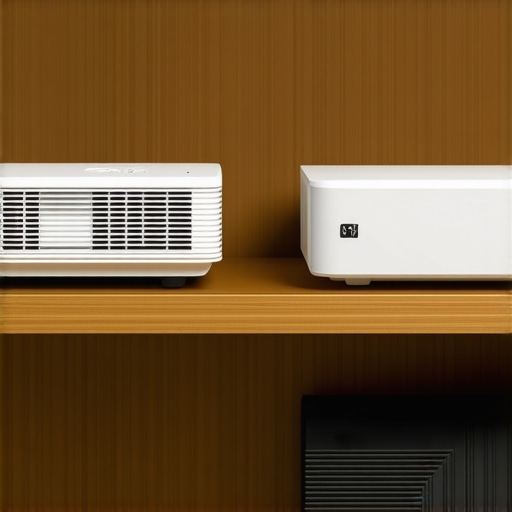
Can an 85-inch OLED Actually Kill Your Home Cinema Vibe?
I often get asked if one should just ditch the home theater deals and buy a massive television instead. It’s a valid question. An OLED will always have better blacks. However, even a 98-inch TV feels ‘small’ compared to a 120-inch projection. The scale of ust projectors creates a cinematic immersion that a glass screen simply cannot replicate. Furthermore, a projector screen doesn’t reflect your furniture or your own face during dark scenes, which is a major distraction on glossy TV panels.
The $300 Problem with Generic Budget Projectors
You will see countless portable projectors on Amazon for under $300 claiming 4K resolution. I am here to tell you: they are lying. These units almost always use a single-panel LCD that is prone to burning and has a resolution that is natively 720p at best. When compared to the genuine 4k projectors I’ve been testing, the difference is like comparing a flip-phone camera to a professional DSLR. The budget units are toys; the units we are discussing are precision optics.
Is it worth the upgrade from a standard lamp-based unit?
If your current projector sounds like a vacuum cleaner and makes your room feel like a sauna, the answer is a resounding yes. Moving to a laser engine isn’t just about the resolution; it’s about the quality of the environment. You can actually hear the whispers in a movie dialogue without cranking the volume to 80%. Before you pull the trigger, I highly recommend checking CamelCamelCamel to see the historical pricing on these units, as they often fluctuate by hundreds of dollars. If you find yourself still leaning toward a traditional setup, you should definitely check out my deep-dive comparison of the Epson 5050UB versus modern laser units to see if the ‘old school’ tech still has a place in your home. For now, let’s wrap up with the final performance metrics.
The Real-World Wins and Design Failures
- The Good: Near-silent operation (under 30dB), a premium metal chassis that dissipates heat far better than plastic, and the instant-on convenience of a laser engine.
- The Bad: Cramped port placement makes thick cables difficult to plug in, and the input lag on certain 4k projectors in this category is too high for competitive gaming.
Pick the Right Tool for Your Dark Room
These laser projector deals are specifically for the movie purist who values atmosphere. If you want to watch films in a bedroom without a fan screaming next to your ear, this is your best bet. However, if you are a gamer, you should definitely check out our research on testing 4k projector input lag for competitive gaming sessions before buying. Also, remember that even high-end ust projectors need help in daylight; read up on why an ALR screen is more important than your projectors brightness to avoid a washed-out image. Skip this if you need a budget solution, as cheap portable projectors simply cannot match this thermal efficiency. #IMAGE_PLACEHOLDER_E#
A Definitive 8.5/10 Rating for the Cinema Obsessed
While no hardware is perfect, the silence and build quality of these units set a new bar for home theater deals. You aren’t just buying pixels; you are buying a distraction-free experience. If you are ready to pull the trigger, our guide on how to find real discounts on high-end laser units will help you save hundreds. This is a clear buy for anyone building a dedicated media room. Check the latest user reviews and price drops before the current stock runs out.