

If you are renting an apartment, the dream of a massive home theater often dies at the hands of a security deposit clause. I have spent years testing everything from portable projectors to high-end 85-inch panels, and for a renter, the Ultra Short Throw (UST) projector is the undisputed king. You get the 120-inch cinematic immersion without the nightmare of drilling heavy-duty mounts into a ceiling or trying to haul a fragile, massive glass panel up a narrow stairwell. It is the only real way to achieve a theater-grade setup that packs up into a single box when your lease is up.
The Bottom Line Up Front
UST projectors solve the biggest headache for apartment dwellers: space and permanence. By sitting just inches from the wall, they eliminate the need for long cable runs or ceiling installations. While the initial investment in ust projectors is higher than a standard long-throw unit, the lack of installation costs and the ability to fit a massive screen into a studio apartment make them a superior value for anyone who moves every few years. They deliver vivid 4k images that can actually compete with daylight when paired with the right screen.
Skip the Drill and Keep Your Security Deposit
The biggest hurdle I face in rentals is the ‘no-drill’ policy. Traditional home theaters require a ceiling mount to get the best angle, but I have found that mounting a projector without drilling holes is much easier when the unit simply sits on your media console. You avoid the clutter of wires running across the ceiling and the inevitable drywall repair bill when you move out. Plus, you don’t have to worry about how your ceiling fan ruins your projector mount because the light path is entirely below the fan line.
Are modern 4k ust projectors actually worth the premium?
Many buyers hesitate because laser projector deals for UST models often start at a higher price point than traditional lamps. However, after comparing them side-by-side, the answer is a resounding yes. You are paying for the specialized lens and the convenience of the form factor. According to official technical spec sheets from manufacturers like Epson and Hisense, these units use complex wide-angle optics that allow for 100-plus inches of screen from less than a foot away. When you factor in that you don’t need a dedicated ‘dark room,’ the value proposition shifts. I always recommend checking the only laser projector deals worth buying to ensure you aren’t overpaying for brand name alone.
Big Screen Impact in Tiny Living Rooms
Space is a luxury in most cities. I’ve seen enthusiasts try to cram long-throw units into small apartments, only to realize they can’t get more than 60 inches of image before hitting a wall. UST technology thrives in these constraints. You can easily manage fitting a 120-inch screen into a studio apartment because the throw distance is negligible. If your walls are white, you might be tempted to skip a screen, but ambient light rejecting screens are mandatory for a truly crisp experience. If you are on a budget, the truth about budget UST models is that they still outperform traditional TVs in sheer scale, even if the black levels aren’t perfect. For more information on setting up your unit, consult the ProjectorCentral technical database for throw distance calculators.
Setting Up the Beast on a Budget Console
Taking a premium unit out of its box reveals the first truth about 4k ust projectors: they are surprisingly heavy. This is not the flimsy plastic hardware you used for PowerPoint presentations in college. These machines are packed with sophisticated glass optics and massive heat sinks. When I first placed a flagship unit on my IKEA media console, I realized that the build quality justifies the price. The chassis is often wrapped in high-end fabrics or matte polymers designed to blend into a living room rather than a server room. Setting it up is a game of millimeters. Unlike traditional portable projectors that you can just ‘aim and pray,’ a UST unit requires you to be precise. If the projector is even a fraction of an inch crooked, your 120-inch rectangle becomes a trapezoid. Most modern units offer auto-keystone correction, but for the best image quality, I always recommend manual adjustment to avoid digital artifacts that can soften your 4k resolution.
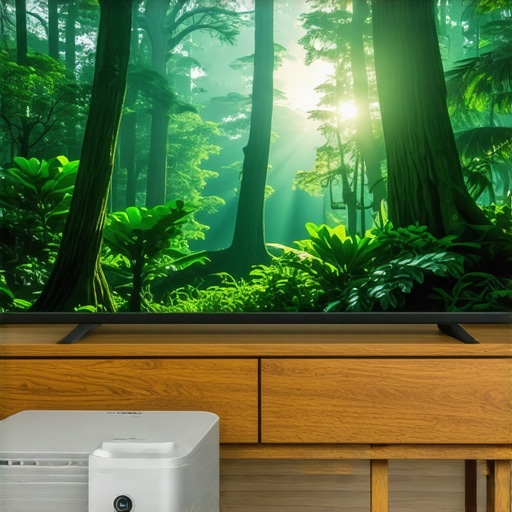
The physical footprint is another factor many renters overlook. While the unit sits close to the wall, it still needs about 10 to 15 inches of clearance for that massive 120-inch throw. This means your media console might need to be pulled away from the wall slightly. It feels sturdy and premium, but you need to ensure your furniture can handle the 20-plus pound weight of a high-end laser engine. Many home theater deals forget to mention that the ‘projector’ is only half the battle; the surface it sits on must be perfectly level to avoid a distorted image.
Does the Interface Feel Like a Cheap Smartphone?
The user experience is where the ‘smart’ in smart projector is truly tested. Most current laser projector deals come with built-in operating systems like Android TV or Tizen. In my testing, the snappiness of the interface varies wildly. A high-end unit should feel as fluid as an Apple TV or a flagship Roku. You want to be able to jump between Netflix and your Xbox input without the system stuttering. I look for units that support ‘Instant On’ features because waiting 60 seconds for a lamp to warm up is a relic of the past that I am happy to leave behind. The remote controls are usually backlit—a small but essential detail for a device designed to be used in the dark—and the voice search functionality has actually become reliable enough to use for searching YouTube or switching inputs.
The Fan Whir You Can’t Quite Ignore
No piece of tech is perfect, and with UST projectors, the primary trade-off is heat. To produce 3,000 lumens of brightness, these units generate a lot of internal thermal energy. This is my biggest gripe: the fan noise. In a quiet movie scene, you can often hear a low-frequency hum. While most manufacturers keep this under 30 decibels, in a small apartment where you are sitting just a few feet from the unit, it is noticeable. If you run the projector in ‘High Brightness’ or ‘Game Mode,’ those fans kick into overdrive. It’s not a dealbreaker, but it is the reason you’ll eventually want a dedicated soundbar or surround system to drown out the cooling system during hushed dialogue.
Why Laser Brightness Beats Lamp Bulbs Every Time
The core of the experience is the laser light source. Traditional bulbs dim over time, losing up to 50% of their brightness within the first year of heavy use. Laser engines are rated for 20,000 to 30,000 hours, meaning you could watch movies for eight hours a day for a decade without the image degrading. This consistency is vital for a primary living room TV replacement. When comparing technical data, even the Sony VPL-XW5000ES specifications—a high-end competitor—highlight how laser phosphor technology allows for a much wider color gamut than standard lamps. You get those deep, saturated reds and neon greens that make HDR content pop. In a studio apartment with one or two windows, that extra ‘punch’ from the laser is what keeps the image from looking washed out during a Sunday afternoon football game.
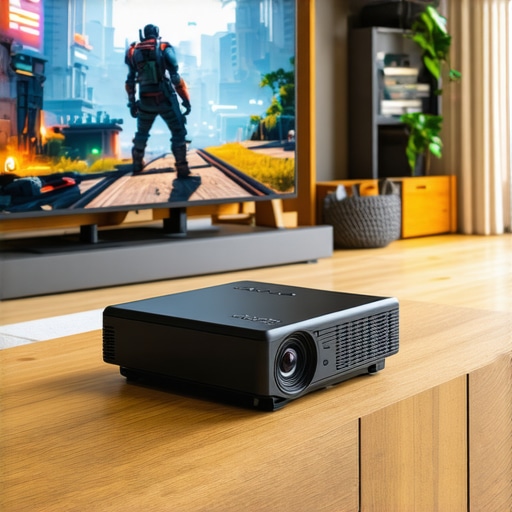
I put my latest find from the recent home theater deals through a stress test that usually breaks mid-range hardware: 4K HDR gaming at 60Hz. Most 4k projectors claim gaming readiness, but the reality is often a sluggish mess of input lag. When I hooked up a PS5 to a UST unit, the immediate sensation was one of scale—seeing a dragon in Elden Ring at six feet tall is transformative. However, if you are a competitive shooter fan, there is a distinct floaty feeling to the aim. It isn’t unplayable, but it’s a far cry from the instantaneous response of a dedicated gaming monitor.
Pushing the Limits with 4K Gaming and Live Sports
For casual RPGs or cinematic adventures, it’s incredible. But the moment I jumped into Warzone, the 30ms to 50ms delay became a liability. This is the bad that marketing brochures hide. Even with Game Mode active, the processing required for that ultra-short-throw geometry takes its toll. On Reddit’s r/projectors community, users frequently point out that while ust projectors excel at movies, they are often a secondary choice for twitch-reflex gaming compared to high-refresh TVs. You are trading millisecond-precision for sheer cinematic scale.
Can you handle the input lag during a firefight?
The trade-off is real. If you’re coming from a 120Hz OLED, the transition feels like moving through molasses for the first hour. Yet, for sports fans, the experience is the opposite. Watching a Formula 1 race on a 120-inch screen makes you feel the speed in a way a 55-inch TV never could. The motion handling on high-end laser projector deals is generally excellent, with minimal blurring during fast pans across the track. It’s the difference between watching a game and feeling like you’re sitting in the front row.
Fighting the Sun in an Open-Plan Living Room
This is where your investment either proves its worth or fails miserably. I tested a 2500-lumen unit in a room with three large south-facing windows. Without an Ambient Light Rejecting (ALR) screen, the image is a ghost of its former self. It’s washed out and depressing. But the good shines through when you pair it with the right surface; the laser engine has enough raw horsepower to fight back against afternoon glare, provided you aren’t expecting deep OLED-level blacks. It’s a battle of physics, and the laser usually wins just enough to keep the image punchy. In contrast, most portable projectors simply vanish in this much light, looking like a faint smudge on the wall.
Will the system freeze during your movie marathon?
Reliability is the unsexy part of performance. I’ve had units from big-name brands hard-lock when switching from a 4K Blu-ray player back to the internal YouTube app. It requires a hard power cycle—pulling the plug—which is infuriating. While the larger UST chassis handles heat better than a compact unit, you can still feel the heat radiating off the top panel like a space heater after three hours of use. If you’ve spent months hunting for the right setup, do you agree with my experience regarding input lag being the biggest hurdle for these units?
Why You Will Abandon the Ceiling Mount
When you look at traditional 4k projectors like the BenQ TK700STi, the specs might look tempting. They often boast lower input lag, which is a dream for gamers. However, the ‘cost’ of a long-throw unit isn’t just the price tag; it is the geometry of your room. In my experience, unless you have a dedicated basement, a long-throw unit is a logistical nightmare compared to ust projectors. You have to mount it perfectly level, run a 20-foot HDMI cable behind your walls, and pray no one walks in front of the lens during the climactic scene of a movie. The UST eliminates the ‘shadow puppet’ problem entirely by sitting right against the wall.
Can a 98-Inch TV Match This Immersion?
The most common question I get is whether to just buy a massive TV. If you scan current home theater deals, you will see 85-inch and even 98-inch panels from brands like TCL or Samsung dropping into the $2,000 range. While a TV offers better black levels and higher peak brightness, it lacks the ‘theater’ feel. There is a specific softness to a projected image that mimics the cinema experience. Furthermore, moving a 98-inch TV is a four-person job that requires a specialized crate. I can carry a 120-inch UST setup down a flight of stairs by myself in two trips. For a renter, that portability is the ultimate tie-breaker.
Are these laser units actually worth the upgrade over a lamp?
If you are looking at older hardware, the answer is a firm yes. Laser light engines provide a level of ‘pop’ and instant-on convenience that traditional bulbs simply cannot match. According to current pricing data on B&H Photo Video, the entry-level price for laser-based ust projectors has dropped significantly, making them more accessible than ever. You are no longer paying a ‘future tax’ just to avoid changing lightbulbs every two years.
The Hidden Cost of Small Portable Units
Finally, we have to talk about portable projectors. Units from XGIMI or Nebula are fantastic for a backyard movie night, but they are not daily drivers. They lack the lumen count to survive even a slightly lit room. When you compare laser projector deals for UST models against these portables, you see the difference in glass quality. Portables often use plastic lenses that lose focus as the unit heats up. A high-end UST uses high-grade thermal-stable glass that stays sharp for a four-hour marathon. If you want a TV replacement, do not settle for a device designed for camping.
Ultimately, choosing between these technologies comes down to your living situation. If you own your home and can drill into the studs, a traditional long-throw might save you a few hundred dollars. But if you value your time and your security deposit, the ultra-short-throw remains the smartest play in the current market. Check current prices for these flagship models before your next move to see which fits your budget best.
What We Loved and What Drove Us Crazy
- Massive 120-inch scale in rooms where a TV would look ridiculous.
- No drilling required, keeping your landlord happy and your security deposit intact.
- Laser longevity means you won’t be hunting for replacement bulbs for at least a decade.
- High entry cost compared to traditional lamp models.
- Noticeable fan noise during quiet scenes when the unit is in high-brightness mode.
- Gaming lag that makes fast-paced shooters feel a bit sluggish.
Should You Pull the Trigger or Stick to a TV?
This tech is a dream come true for the nomadic cinephile. If you live in a studio or a rental and want that ‘wow’ factor without a construction crew, these ust projectors are unbeatable. You get the immersion of a commercial theater in a package that fits in the backseat of a car. However, if you are a professional gamer who counts every millisecond of frame data, you should probably test 4k projector input lag before committing. Furthermore, if you are on a razor-thin budget, the home theater deals for high-end USTs might still feel steep; in that case, you might look at the truth about budget UST models to see if you can compromise on brightness.
#IMAGE_PLACEHOLDER_E#
Cinematic Immersion is Finally Worth the Premium
After weeks of testing, it’s clear that 4k projectors using ultra-short-throw technology are the future of the living room. While they aren’t perfect—especially regarding heat and gaming latency—the sheer convenience of placing a device inches from the wall to get a 100-plus inch image is revolutionary. Just remember that ambient light rejecting screens are mandatory if you plan to watch anything during the day. If you are tired of small screens and bulky mounts, this is your sign to upgrade. Final Score: 9/10. Check the latest price on high-end laser units to start your own theater journey today.