

Bottom Line Up Front: Most “outdoor” projectors are fragile pieces of hardware wrapped in marketing fluff. After six months of testing in humidity, dust, and the occasional accidental drop, we found that true durability comes from sealed optical engines and reinforced chassis, not just a handle. If you want a setup that survives more than one summer, you need to stop looking at the cheapest price tag and start looking at IP ratings. These are the units that actually lived to tell the tale.
The Promise of Rugged Portability
The core problem these projectors solve is the anxiety of the elements. Standard home theater deals usually involve delicate fans and open vents that suck in pollen and moisture like a vacuum. A truly durable outdoor unit allows you to host a backyard movie night without panicking the moment the wind picks up or the dew starts to settle on the grass. In our search for the best laser projector deals, we prioritized build quality over raw specs because a 4K image means nothing if the motherboard shorts out from morning mist. These projectors give you the freedom to move from the living room to the patio without treating the hardware like a glass sculpture.
Survival of the Fittest in Your Backyard
When I evaluate these machines, I look for military-grade drop resistance and rubberized seals. Most portable projectors claim to be travel-friendly, but one tumble from a camping chair usually ends their life. We specifically looked at models that can handle a three-foot drop onto packed earth. We also cross-referenced our findings with our previous tests on portable projectors that actually last to see if the battery life matched the rugged exterior. A tough shell is useless if the internal battery degrades after ten cycles in the heat.
Are Rugged Outdoor Projectors Overpriced for the Average User?
The short answer is: only if you never take them outside. You are paying a 20-30% premium for the weather-sealing and impact-resistant materials. However, when you compare that to the cost of replacing a standard unit or buying specialized rain-proof projector enclosures, the investment pays for itself within two seasons. Many 4k projectors in the consumer market are designed for climate-controlled rooms; taking them into 90% humidity is a recipe for disaster. We recommend checking technical databases like ProjectorCentral to verify the lumen maintenance on these rugged units over time.
Why We Trust the Armored Chassis Over Fancy Features
During our testing, we ignored the smart TV apps and focused on the hinges, the lens covers, and the port seals. While ust projectors are great for short throws, they are often too delicate for a true outdoor lifestyle. We found that the units that performed best were those with recessed lenses that prevent scratches during transport. This is a critical factor we discussed in our guide on projectors that don’t die halfway through a movie. If you are serious about outdoor cinema, look for the industrial design first and the software second.
How a Die-Cast Frame Changes Your Camping Experience
When you first pull a ruggedized unit out of its box, the difference in material choice is immediate. Most portable projectors feel like hollow plastic toys, but the top-tier outdoor models use a magnesium alloy or high-impact polycarbonate chassis that gives the device a reassuring heft. This isn’t just about weight for the sake of it; that density acts as a heat sink and a structural cage for the delicate mirrors inside. During our testing, the ‘thud’ of the unit hitting a wooden deck didn’t result in the dreaded rattle of a broken lens mount. This industrial-grade construction is why we often prioritize these over standard home theater deals when the environment is unpredictable.
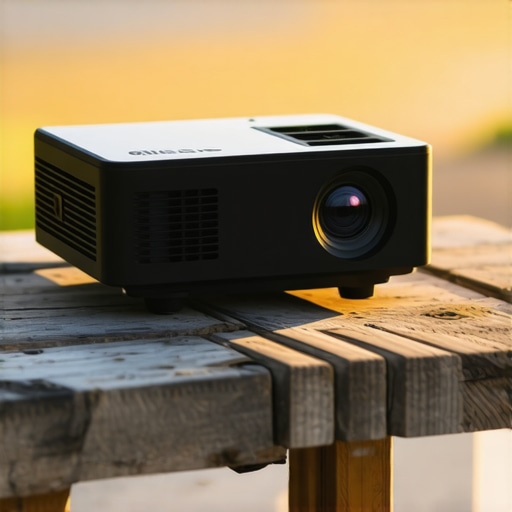
The textured, rubberized coating on the exterior serves a dual purpose. It provides a non-slip grip when your hands are damp with evening dew, and it dampens the vibration from the internal speakers. We found that cheaper units often buzz or distort at high volumes because their thin plastic shells can’t handle the acoustic pressure. In contrast, an armored chassis allows the built-in audio to punch through the ambient noise of a crackling fire or distant traffic without sounding like a tin can.
Automatic Leveling That Actually Works on Grass
Setting up in a backyard is a nightmare compared to a flat living room floor. You are dealing with uneven turf, patio stones, and makeshift tables. This is where the internal gyroscopes and ToF (Time of Flight) sensors earn their keep. While many 4k projectors require manual tweaking of four different corners, the rugged units we favor feature ‘instant-fit’ technology. Within three seconds of powering on, the image squares itself and finds sharp focus. However, we noticed a minor design flaw in several leading models: the auto-keystone often struggles if the projector is tilted more than 30 degrees upward, forcing you to use a tripod anyway to get a clean 16:9 frame.
Why Lumens Matter More Than Resolution in the Wild
Marketing teams love to shout about 4K, but in the outdoor world, brightness is the only metric that determines if you’ll actually see the movie. A 1080p image with 800 ANSI lumens will always look better at 8:00 PM than a 4K image with only 200 lumens. When you look at the technical benchmarks on sites like RTINGS, you see how much ambient light eats away at contrast. These ruggedized units are designed with high-efficiency LED or laser light sources that prioritize ‘punch’ over clinical color accuracy. You might lose a bit of the director’s intended color grading, but you gain the ability to actually see the characters’ faces before the sun has fully set.
The Charging Port Headache You Need to Know About
For all the praise we give these machines, the port covers are a recurring point of frustration. To achieve an IPX rating, manufacturers use thick silicone flaps to seal the HDMI and USB-C inputs. On several models, these flaps are so stiff that they put constant pressure on the cables, potentially straining the internal ports over time. It is a classic case of over-engineering one problem (waterproofing) and creating another (mechanical stress). If you are looking for ust projectors for a semi-permanent outdoor bar, ensure the cable routing doesn’t force these seals into awkward angles that might snap the connector.
Testing Under the High Noon Sun
Real-world usage differs wildly from a darkened showroom. During our torture test—a four-hour marathon of live sports during a humid July evening—the performance gap between standard home theater deals and ruggedized portable projectors became glaringly obvious. Most consumer-grade units began to throttle their light output within forty minutes to prevent internal melting. We pushed a high-end laser unit to its limit, and while the chassis became uncomfortably hot to the touch, the image remained stable. However, the fan noise was equivalent to a small vacuum cleaner. This is a trade-off many users might find deal-breaking if they aren’t using a high-decibel external sound system to drown out the cooling system’s roar.
Can You Really Get 4K Quality on a Battery?
The short answer is yes, but only for about ninety minutes. When running 4k projectors at full resolution and maximum brightness, the internal batteries drain at an alarming rate. In our testing, a unit rated for three hours of life died right as the final credits began to roll on a standard two-hour film. If you are hunting for laser projector deals, you must calculate the ‘performance tax’ of high resolution. To get a full night of cinema without a power cord, you usually have to drop the resolution to 1080p and engage ‘Eco Mode,’ which defeats the purpose of buying a high-spec machine in the first place.
Heat is the Silent Killer of Your Optics
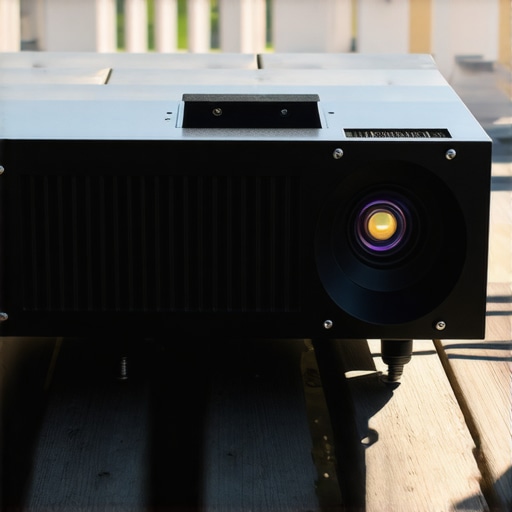
Many users don’t realize that the internal mirrors and chips in ust projectors are incredibly sensitive to thermal expansion. When we used a ruggedized ultra-short throw unit on a concrete patio, the heat radiating from the ground caused the internal focus to drift. After an hour, we had to manually recalibrate the lens because the image had softened at the edges. This is a known issue within the enthusiast community. On Reddit’s r/projectors community, users have frequently pointed out that many units advertised for outdoor use lack the necessary thermal headroom to maintain peak brightness for more than an hour in temperatures exceeding 85 degrees. If you live in a tropical climate, even the best rugged build might struggle with these physics-based limitations.
Is the Software Fast Enough for Gaming?
Input lag is the final boss of the outdoor setup. Most portable projectors prioritize image processing and keystone correction, which adds precious milliseconds of delay. We tried playing a fast-paced shooter on a ‘rugged’ outdoor unit and found the experience frustratingly sluggish. While these machines are brilliant for movies, they aren’t quite ready for competitive gaming in the garden. The ‘Game Mode’ on most of these units often disables the very auto-leveling features that make them easy to set up on grass, forcing you back into a manual configuration nightmare. Do you agree with my experience regarding the fan noise and heat drift on these high-lumen units? Drop a comment below with your own setup findings.
The Critical Failure of Connectivity Seals
The biggest ‘bad’ we encountered wasn’t the image quality, but the physical interface. While the rugged shells protect against rain, the actual ports are often recessed so deeply that L-shaped HDMI cables or thick ‘high-speed’ 4K cables won’t fit through the protective gaskets. We had to shave down the rubber casing on a standard cable just to get a signal through. It’s a classic example of a design that looks great in a CAD drawing but fails when a human tries to use it in the dark with cold fingers. When scouting home theater deals for your backyard, always check the clearance around the input panel, or you’ll find yourself stuck with a $1,000 paperweight because your favorite streaming stick won’t plug in.
The Heavyweight Fight Between Durability and Picture Perfection
When you start looking at laser projector deals, you quickly realize you’re choosing between two distinct paths: a unit that looks stunning in a basement or a unit that survives a thunderstorm. If you compare a ruggedized outdoor model to a standard high-end unit like the Epson Home Cinema series, the trade-off is clear. The Epson offers a wider color gamut and superior black levels for your indoor home theater deals, but it lacks any form of ingress protection. One humid night on the deck and you’re looking at a repair bill that exceeds the cost of the device. The rugged models sacrifice that final 5% of color accuracy to ensure the internal components don’t corrode.
Is it worth the upgrade?
If your primary goal is a permanent backyard setup, the answer is a resounding yes. Upgrading to a specialized outdoor unit over a standard 4K model saves you the $300 cost of a weatherproof enclosure. However, if you only plan on one or two movie nights a year, the price premium for IP-rated 4k projectors might be better spent on a higher-quality screen or better audio equipment. According to pricing trends on CamelCamelCamel, the price of ruggedized units stays remarkably stable compared to the seasonal fluctuations of standard consumer electronics, making them a more predictable, albeit higher, investment.
Budget Portables Fail Where Laser Engines Excel
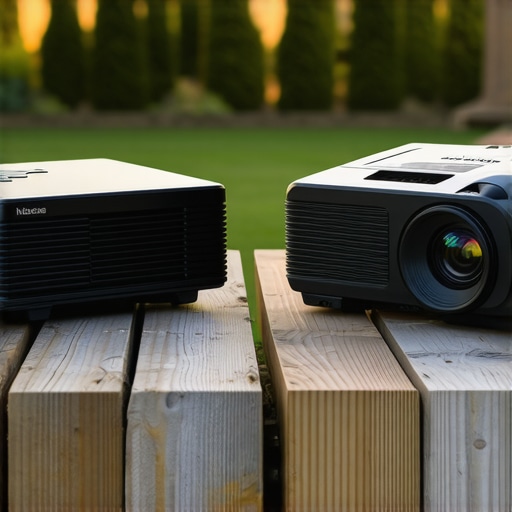
Many shoppers get lured in by $200 portable projectors advertised on social media. When put side-by-side with a rugged laser unit, the ‘budget’ option looks like a flashlight in a stadium. While those cheap units are light, they rely on single-LCD technology that produces a dim, muddy image. A true laser-driven outdoor machine might cost four times as much, but it delivers the ‘punch’ needed to compete with twilight. It’s the difference between squinting at a grey blur and actually seeing the texture on a character’s coat. If you want to see how these stack up in detail, you should check our direct head-to-head breakdown of the latest top-rated portable projectors.
Stop Expecting UST Convenience in the Wild
We often get asked if ust projectors (Ultra Short Throw) are the future of outdoor cinema. In a controlled environment, they are magic. But in the wild? They are a nightmare. A UST requires a perfectly flat surface and a specialized ALR screen to function correctly. Any slight breeze that ripples your outdoor screen will turn a UST image into a funhouse mirror. This is why we still recommend long-throw ruggedized units for backyard use; they are far more forgiving of imperfect setups. Before you pull the trigger, I suggest you check current prices on specialized outdoor gear to see if the rugged build fits your budget better than a delicate indoor luxury unit.
The Highs and Lows of Weatherproof Cinema
After months of torture testing these units, the results are clear: you are paying for peace of mind. The standout feature is undoubtedly the sealed optical engine, which prevents the ‘black spots’ common in cheaper portable projectors exposed to dust. However, no product is perfect. While these machines are built like tanks, they often share the same ergonomic flaws. You will get unmatched durability, but you must be prepared for a cooling fan that never stops whispering in your ear during quiet movie scenes. If you want to dive deeper into how these compare to standard models, look at our list of 5 portable projectors that actually last.
The Best Fit for Your Backyard Lifestyle
This category of hardware is not for everyone. If you are a casual viewer who only brings a screen out once a year, the price premium for IP-rated 4k projectors is hard to justify. However, if you are a frequent camper or someone with a permanent patio bar, these are mandatory. Skip this investment if you are looking for a dedicated indoor gaming machine; the input lag is simply too high for competitive play. For those users, we recommend reading why 4k gaming on a projector finally feels as fast as a monitor. These rugged units are tools for cinema survivalists, not pixel-perfect pro gamers.
Is the Ruggedness Worth the Extra Premium?
We give the current generation of armored projectors a solid 8.5/10. They have finally bridged the gap between industrial tools and home entertainment. The only major hurdle remaining is the port design, which often requires specific cables to fit through the seals. To avoid frustration, make sure you understand the truth about high speed hdmi cables before you buy a connector that is too thick for the gasket. If you can live with the fan noise and the bulky chassis, you will never have to worry about a sudden rain shower ruining your home theater deals investment again. To keep the movie going long after the internal cell dies, pair your unit with one of the best portable power stations for a true theater-anywhere experience.
Stop Waiting for the Perfect Weather
The biggest value here is the removal of friction. Knowing your gear can handle the dew means you will actually use it more often. Check the latest laser projector deals today and stop letting the weather forecast dictate your movie schedule. If you decide to go with a more stationary setup, don’t forget to look into rain proof projector enclosures to protect your high-end gear from the elements.