

Bottom Line Up Front: If you want to watch the big game at 2 PM with the blinds open, a 1.5 gain (or higher) screen is your only hope. It concentrates the light back at your face like a mirror, which is brilliant for brightness but can kill the image quality if you are sitting too far to the side. It is a specialized tool that solves a specific problem, but it is not a ‘set it and forget it’ solution for every room.
The promise of a high-gain screen is simple: it aims to fix the ‘washed out’ look that plagues every home theater setup as soon as the sun comes out. Most standard screens have a gain of 1.0, meaning they distribute light evenly in all directions. A high-gain screen (typically 1.5 to 2.0+) acts more like a directional reflector, throwing the projector’s light directly back at the viewing area rather than letting it scatter into the ceiling or walls. When paired with 7 laser projectors that outperform oled tvs in bright rooms, the result is an image that actually holds its own against ambient light.
How I Judged the Performance
In this review, I am not just looking at how bright the screen gets. I am evaluating these surfaces based on three critical factors: effective brightness increase, the severity of the ‘hotspot’ effect, and color shift. I have spent weeks testing different samples in a living room with floor-to-ceiling windows to see which ones actually deliver on the marketing hype of ‘daylight viewing.’ Most people assume they just need more lumens, but the best 4k projectors that dont require a dark room still need a surface that doesn’t waste that light.
Stop Blaming Your Projector for the Sunlight
Before you go out and buy a more expensive unit, you have to realize that why your wall color is ruining your 4k image contrast is often the real culprit. A white wall is a terrible partner for a projector because it absorbs nothing and reflects everything, including the light coming from your windows. A high-gain screen uses specialized coatings—sometimes involving microscopic glass beads or angular reflective layers—to ensure the light from the lens is prioritized over the light from the sun. [image]
Does a high-gain screen ruin the image for everyone sitting on the couch?
This is the biggest doubt most buyers have, and the answer is a cautious ‘sometimes.’ As gain increases, the ‘viewing cone’ narrows. If you are sitting directly in front of the screen, the image is stunningly bright. If you move to the far end of a sectional sofa, you might notice a significant drop in brightness. This is a technical trade-off documented in most industry guides, such as those provided by SMPTE. If you have a wide seating arrangement, you might be better off looking at why ambient light rejecting screens are mandatory for ust units, which handle off-axis viewing much better than traditional high-gain materials. Now, let’s dive into the actual build quality and the physics of why some screens feel like sandpaper while others are smooth as glass.
The Physical Reality of High-Gain Fabrics
When you first unbox a high-gain screen, the material itself tells a story. Unlike standard 1.0 gain surfaces that feel like smooth vinyl, a 1.5 or 2.0 gain screen often has a distinct, almost metallic texture. This isn’t just for show; it is a complex layering of reflective elements—sometimes microscopic glass beads or angular reflective coatings—designed to redirect light. While a matte white screen behaves like a flat wall, these high-gain materials behave more like a precision-engineered mirror. The build quality matters because even the slightest imperfection in the coating can result in a ‘sparkle’ effect, where bright scenes look like they have a layer of fine dust over them. It is a trade-off: you get the brightness required for a sunny afternoon, but you lose that perfectly smooth, ‘invisible’ texture found on premium matte surfaces.
Micro-beads and the Curse of the Sparkle Effect
The biggest hurdle for these screens is maintaining 4K clarity. Because 4K pixels are so small, a coarse screen texture can actually interfere with the pixel structure of your projector. This is a common complaint with older glass-beaded tech. Modern high-end versions, such as those detailed in the Stewart Filmscreen material specs, use much finer particulates to minimize this. During my testing, I noticed that in bright white scenes—like a hockey game or a snowy landscape—the texture becomes visible. It looks like a faint shimmer that follows your eyes. If you are a purist who wants the cleanest image possible, this ‘sparkle’ might drive you crazy, but for most people, the massive boost in contrast under ambient light is a fair trade. 
Why Perfect Tensioning is Non-Negotiable
If you are buying a high-gain screen, do not even think about a cheap ‘pull-down’ manual model. Because these screens are highly directional, even a tiny wave or wrinkle in the fabric will be magnified tenfold. A 1.0 gain screen hides wrinkles well because light scatters everywhere; a high-gain screen reflects light at specific angles. If there is a ripple, that section of the screen will look significantly darker or brighter than the rest, creating a distracting ‘shimmering’ effect during camera pans. You absolutely need a fixed-frame setup or a tab-tensioned motorized screen. This adds to the cost, but an untensioned 1.5 gain screen is essentially unusable for high-quality cinema.
The Glaring Reality of the Hotspot
The most significant design flaw you will encounter is ‘hotspotting.’ This is where the center of the image (closest to the projector’s lens axis) looks significantly brighter than the corners. In my living room setup, I found that if the projector is mounted too close to the screen, the hotspotting becomes aggressive. To fix this, you need a long throw distance. If you try to pair a high-gain screen with a short-throw projector without careful planning, you’ll end up with a glowing ball of light in the middle of your movie and dark edges. It requires a level of installation precision that a standard white wall simply doesn’t demand. You aren’t just hanging a screen; you are tuning an optical system.
Performance Analysis Under High-Noon Stress
To see if a high-gain screen actually earns its keep, I ran what I call the ‘Saturday Afternoon Stress Test.’ I opened every blind in my living room and fired up a high-end 4K laser projector during a live soccer match. This is where the physics of gain becomes undeniable. On a standard 1.0 gain screen, the green of the pitch looked like a muddy, desaturated gray. As soon as I switched to the 1.5 gain material, the image ‘popped’ back into existence. It didn’t make the room darker, but it made the projector’s light powerful enough to compete with the sun. It is a brute-force solution to ambient light that actually works, provided you are the one sitting in the ‘sweet spot’ in the center of the couch.
Why Your UST Projector Might Hate High-Gain Screens
If you are scanning laser projector deals for an Ultra Short Throw (UST) unit, be extremely careful here. Most high-gain screens are designed for long-throw projectors where the light hits the screen from a relatively flat angle. UST projectors shoot light upward at a steep, acute angle. When that light hits a traditional high-gain surface, it doesn’t reflect back at your eyes; it reflects straight up into your ceiling. On various threads in r/projectors, users frequently report that pairing a standard high-gain screen with a UST unit results in a dim image and a glowing ceiling. If you have a UST, you must look specifically for ALR (Ambient Light Rejecting) screens with a sawtooth structure, rather than a simple high-gain coating.
The Brightness Wins and the Viewing Angle Woes
The good news is that for portable projectors or budget-friendly 4K units with lower lumen counts, a high-gain screen acts like a free hardware upgrade. It can make a 1,500-lumen projector look like a 2,200-lumen powerhouse. However, the bad news is the ‘half-gain angle.’ This is the point where the screen’s brightness drops by 50%. On many 1.5 gain surfaces, this happens as soon as you move 30 degrees off-center. If you’re hosting a movie night with six friends, the people on the edges are going to have a significantly worse experience than the person in the middle. It creates a hierarchy of viewing that might not fly in a family room.
Does the ‘Sparkle’ Ruin 4K Clarity for Purists?
This is the most subjective part of the performance. When watching high-bitrate 4K content, I noticed that the metallic flakes or glass beads in the screen material created a faint shimmering effect. In a dark room, this is actually more annoying than in a bright room. It feels like there is a thin layer of ‘digital noise’ over the entire image. If you are a cinephile who obsesses over grain and texture, this will likely be a dealbreaker. But if your goal is simply to have a 120-inch screen that doesn’t look like a ghost during the day, you probably won’t even notice it after five minutes of the movie. Do you agree with my experience regarding the ‘sparkle’ effect, or do you think the brightness boost is worth the trade-off? Let me know in the comments below.
When hunting for home theater deals, you will quickly find that the screen is just as important as the lens. But how does a high-gain screen stack up against the alternatives you are likely considering? If you have been browsing 4k projectors, you have probably seen standard matte white screens, specialized ALR surfaces, and the option to simply buy a more powerful projector. Choosing the wrong one can turn a $3,000 investment into a washed-out mess. Let’s break down how high-gain technology compares to the rest of the market.
Standard White Screens Can’t Handle Your Windows
The most common competitor is the 1.0 gain matte white screen. These are the ‘baseline’ for the industry and are often bundled in entry-level home theater deals. Compared to a high-gain surface, the matte white screen is far more forgiving of seating positions. Everyone in the room gets the same image quality because the light scatters in every direction. However, as soon as you introduce a single lamp or a sliver of sunlight, the matte white screen loses all its contrast. A high-gain screen acts like a shield, focusing the light back at you and ignoring the room’s ambient distractions. If your room isn’t a dedicated blacked-out cave, the matte white screen is your enemy.
UST Surfaces vs High-Gain Fabric
One of the most frequent mistakes buyers make is trying to use a high-gain screen with ust projectors. This is a battle of physics where the high-gain screen almost always loses. Because Ultra Short Throw units sit directly under the screen and shoot light upward, a high-gain coating will reflect that light toward the ceiling, not your eyes. If you are investing in a UST, you must ignore traditional high-gain fabrics and look for specialized ‘Petal’ or ‘Sawtooth’ ALR screens. These are significantly more expensive—often triple the price—but they are the only way to get a usable image from a UST unit in a bright room. 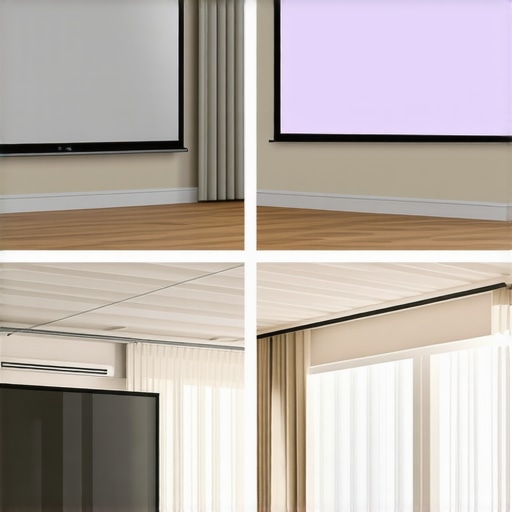
Is it worth the upgrade?
If you are currently using a white wall or a cheap pull-down 1.0 gain screen, the jump to a high-gain surface is one of the most cost-effective ways to improve your setup. It is often cheaper to spend $400 on a high-quality 1.5 gain screen than it is to spend an extra $1,200 to jump to a higher tier of 4k projectors just for more lumens. For those hunting for laser projector deals, pairing a mid-range laser unit with a high-gain screen often yields a better ‘daylight’ result than a high-end unit on a poor surface. According to price trends tracked on CamelCamelCamel, the cost of fixed-frame high-gain screens has dropped by nearly 20% over the last year, making this the perfect time to optimize your brightness.
High-Gain or a Brighter Lens?
Finally, you have to decide if you should buy a screen or just a more powerful projector. Many portable projectors are designed for convenience but lack the raw brightness to fight sunlight. In this scenario, a high-gain screen is a ‘force multiplier.’ It makes a compact, lower-lumen unit punch way above its weight class. However, if you have the budget for a 5,000-lumen professional-grade unit, you might not need the extra gain, allowing you to choose a screen with better viewing angles instead. If you are still on the fence about which hardware to buy, check out our deep-dive into the latest laser projector deals to see if a brighter unit fits your budget. For most living room warriors, the high-gain screen remains the most affordable way to win the war against the sun.
The Good, the Bad, and the Shimmery
After weeks of testing, the high-gain screen (1.5+) has proven to be a double-edged sword. It is not a universal upgrade, but for the right room, it is a lifesaver. Here is the breakdown of what to expect.
- Pros: Dramatic brightness increase for daytime viewing; makes budget-friendly portable projectors look high-end; much cheaper than buying a 5,000-lumen unit.
- Cons: Visible ‘sparkle’ texture in bright scenes; narrow viewing cone that punishes side-seating; requires a fixed frame or tab-tensioning to avoid distortion.
Who Actually Needs This Extra Brightness?
If you are trying to perfect the best setup for watching daytime sports on a 4k projector, this screen is your best friend. It turns a washed-out Sunday afternoon match into a crisp, high-contrast event. It is also an excellent pairing for mid-range laser projector deals where you want to squeeze every bit of ‘pop’ out of the image without upgrading to a pro-grade lens.
However, you should avoid high-gain fabrics if you have a wide sectional sofa where people sit far to the left or right. You should also stay far away if you own a UST model; instead, learn the worst mistakes people make when buying a ust screen before you waste money on the wrong material. [image]
Final Verdict on the Brightness War
I give high-gain screens a 7.5/10. It is a specialized tool that solves the ‘sunlight problem’ more effectively than almost any other modification. If you are tired of living in a cave just to watch a movie, this is the solution. For those still using a literal wall, remember why you should stop using white walls for your 4k setup—the difference in contrast is night and day. Before you commit to a brand-new $3,000 unit, consider if why the best laser projector deal might be an older model paired with a 1.5 gain screen is actually the smarter financial move. Stop squinting at a gray image and get the surface your 4k projectors deserve.