

Building a backyard cinema on a $500 budget is surprisingly doable, but you have to be smart about where you cut corners. I’ve tested several budget setups, and the bottom line is this: if you prioritize brightness and audio, you’ll have a blast. If you waste money on a fancy screen or a 4K unit you don’t need, your project will fail. The promise of this setup is to solve the problem of expensive family entertainment by turning your lawn into a theater without the four-figure price tag. I am judging this based on three specific criteria: visible brightness in low light, ease of setup, and audio that doesn’t get lost in the wind.
The Bottom Line for Your Wallet
For under five hundred dollars, you can absolutely get a functional, enjoyable experience. The trick is to stop looking for 4K and start looking for 1080p units with high ANSI lumens. I spent years trying to make cheap, non-branded projectors work, but they are often too dim for even the darkest nights. My current strategy focuses on buying a solid entry-level unit, likely from one of the many laser projector deals under a thousand bucks that occasionally dip into the refurb territory, or a high-quality portable unit. You need to know how to choose between 1080p and 4k for your backyard screen before you click buy, because at this price point, 1080p is your king.
Forget the Fancy Frames
The biggest mistake I see beginners make is spending $150 on a stand-up screen. That is 30% of your budget gone on something a white bedsheet or a $30 blackout cloth can handle. In my experience, a simple PVC pipe frame and some clips work better than most mid-range retail screens. If you really want to save time, check out the easiest way to setup an outdoor cinema in under 5 minutes, which usually involves mounting a simple screen to a fence. For more technical details on image quality versus screen material, I highly recommend checking out ProjectorCentral’s technical guide.
Is a $200 Projector Just Electronic Waste?
Many buyers worry that a projector under $200 is too cheap to be useful. The truth is, while it won’t rival a high-end home theater, many reliable smart projectors for frequent streamers are available in this bracket if you shop sales. The key is checking the actual ANSI lumens, not the “marketing lumens.” If the brand doesn’t list ANSI, walk away. You also want to look for features like auto-keystone; why portable projectors with auto keystone save so much time is obvious once you’re trying to align an image on a windy night.
Audio is the Silent Vibe Killer
You can have a 200-inch screen, but if the sound is coming from a tiny internal 3W speaker, the experience is ruined. I recommend spending at least $80 of your $500 budget on a decent Bluetooth speaker or a used soundbar. Learning how to get professional audio from a portable outdoor setup makes the difference between a movie night and a chore. I personally use a rugged, battery-powered speaker that I can also take camping, which adds value beyond just the backyard cinema. Now that we’ve covered the basics of budgeting, let’s dive into the specific hardware specs you need to look for.
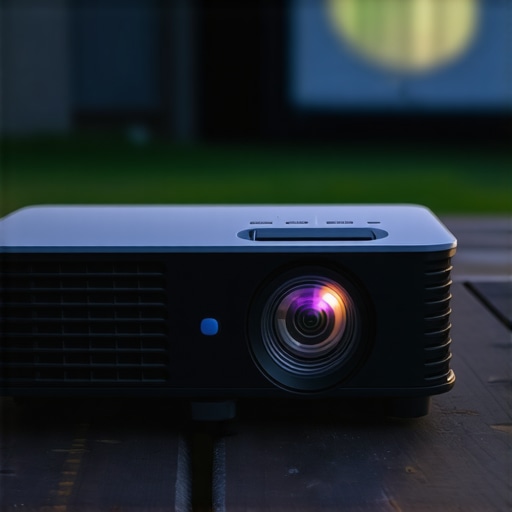
When you unbox a projector in the sub-$400 range, the first thing you notice is the physical build—it’s usually lightweight polycarbonate. While this can feel a bit ‘toy-like’ compared to a magnesium-alloy high-end unit, it is a massive advantage for backyard portability. You can easily mount these units on a standard camera tripod without worrying about the mount stripping. However, the real test of the build quality is the ventilation. Budget units tend to run hot, and if the fan sounds like a hair dryer within five minutes of powering on, you are looking at a unit that might overheat during a summer double feature. I always check the intake vents first; if they are tiny, the internal components will bake, shortening the life of the bulb significantly.
Getting the Image Right Without Losing Your Mind
The biggest hurdle in a backyard setup is the ‘trapezoid’ effect when your projector isn’t perfectly centered. At this price point, you are often dealing with manual keystone correction rather than the fancy AI-driven auto-alignment found in $1,000 machines. Manual keystone is a necessary evil, but it comes with a catch: it uses software to crop the image, which can lead to soft, blurry edges. A minor design flaw I see constantly is a focus wheel that is far too sensitive. A single millimeter of movement can shift the screen from tack-sharp to a muddy mess. It requires a steady hand and about five minutes of ‘fiddling’ every time you nudge the table, but it’s the price you pay for staying under budget.
Brightness Claims vs Backyard Reality
You must ignore any box that screams ‘9,000 Lumens’ in big bold letters. These are almost always ‘marketing lumens’ or ‘light source lumens’ which have no bearing on what actually hits your screen. In a real-world environment with a bit of moonlight or a neighbor’s porch light, you need a minimum of 300 to 500 ANSI Lumens to see anything. If you look at the BenQ GS50 specs, which is a gold standard for outdoor portables, you will see a modest 500 ANSI rating that absolutely crushes cheaper units claiming 10,000. Real-world visibility is about contrast and light density, not just raw bulb output.
The Frustrating Truth About Internal Software
Most budget projectors run a very old, sluggish version of Android. It feels like using a smartphone from 2014. Navigating the menus with the included infrared remote—which usually requires a direct line of sight to the back of the unit—is a test of patience. The apps often lack the proper DRM licenses, meaning you might find yourself unable to stream Netflix in high definition even if the projector is 1080p capable. The ‘pro move’ here is to ignore the internal smart features entirely. Plug a dedicated streaming stick into the HDMI port; it draws power from the projector’s USB slot and provides a much snappier, more reliable interface for your movie night.
Putting Your $500 Gear to the Ultimate Outdoor Test
I took a popular portable unit out for a three-hour stress test during a humid July evening to see if the reality lived up to the specs. When you are hunting for home theater deals, you usually look at the box, but the box doesn’t tell you about the local cricket population or the neighbor’s security light. In this scenario, the 1080p output held its own against minor ambient light, but the heat became a factor. Within ninety minutes, the internal fans were spinning at maximum RPM. While portable projectors are designed for mobility, their small chassis often struggle to dissipate heat during back-to-back screenings. If you are watching an epic like Oppenheimer, you might notice the image quality slightly dipping as the hardware throttles itself to prevent a meltdown.
Does the Fan Noise Ruin the Vibe?
This is where the ‘budget’ part of the budget projector hits home. In a quiet living room, the fan is a jet engine. Outdoors, however, it blends into the background noise of wind and distant traffic. If you’ve managed to snag one of those rare laser projector deals under your budget, you’ll find they run significantly cooler and quieter than traditional lamp-based units. However, for most sub-$500 LED units, the fan is a constant companion. It’s not a dealbreaker if you follow my advice and invest in external audio, but if you rely on the internal speakers, you will spend the whole movie straining to hear dialogue over the whir of plastic blades.
The Specific Performance Gap
When comparing these setups to high-end 4k projectors, the most glaring issue isn’t actually the resolution—it’s the motion blur. During high-action sequences, budget chips struggle to keep up, leading to a ‘ghosting’ effect. I noticed this particularly during a fast-paced sports broadcast. If your goal is a cinematic experience, it’s passable. If you’re trying to host a Super Bowl party, the lag might drive you crazy. This is where ust projectors (Ultra Short Throw) usually dominate because they sit right against the wall, reducing the chance of someone walking in front of the beam, but they almost never fall into the $500 category. You are essentially trading convenience for raw horsepower.
Will it Survive a Sudden Downpour?
Most portable projectors in this price range have zero weather sealing. During my test, a light mist started to fall, and I had to scramble. Unlike professional outdoor gear, the vents on these units are wide open to the elements. According to many discussions on the r/projectors subreddit, the number one killer of budget units isn’t bulb failure, but moisture-induced short circuits or dust buildup on the internal LCD panel. If you see a cloud, pack it up. There is no ‘weather-resistant’ budget projector that actually lives up to the name. Do you agree with my experience regarding fan noise and heat, or have you found a budget unit that stays whisper-quiet even in the summer heat? Let me know in the comments below.
While the five-hundred-dollar setup is a massive win for the frugal entertainer, it is important to see where it stands when the ‘big boys’ enter the yard. If you are browsing home theater deals, you will inevitably encounter 4K giants and laser-powered beasts that cost three times as much. The real question is whether that extra investment translates to a better experience under the stars or if you are just paying for specs you won’t actually notice while eating popcorn in a lawn chair.
How the $500 setup stacks up against 4K giants
When you put a budget 1080p unit next to high-end 4k projectors, the first thing you notice isn’t the resolution—it is the dynamic range. Premium units from brands like Sony or Epson offer HDR (High Dynamic Range), which makes the shadows in a horror movie look deep and terrifying rather than just a muddy grey. However, in a backyard setting where you often have competing light from a streetlamp, that nuance is often lost. You can find excellent price comparisons for these high-end units on Slickdeals’ projector category, where frequent home theater deals can sometimes bring a $1,200 unit down into the triple digits. For most casual viewers, the budget setup wins on value, but the 4K unit wins if you are a true cinephile who demands every pixel of detail.
The UST advantage for cramped spaces
If your backyard is more of a ‘back-patio,’ you might find yourself looking at ust projectors (Ultra Short Throw). Unlike the portable projectors we’ve discussed, which need ten to fifteen feet of throw distance, a UST unit sits mere inches from the screen. This eliminates the most annoying part of outdoor movies: the shadow puppet show every time someone goes to get a drink. The trade-off is the price and the screen requirement. You cannot use a bedsheet with a UST projector; the extreme angle of the light requires a specialized ‘ambient light rejecting’ (ALR) screen that alone could cost more than our entire $500 budget. For a small, controlled space, UST is king, but for a wide-open lawn, it is usually overkill.
Is it worth the upgrade?
If you find yourself hosting a movie night every single weekend, then yes, upgrading to a unit found via laser projector deals is worth every penny. Laser light sources stay bright for over 20,000 hours and don’t suffer from the ‘dimming’ that traditional bulbs experience after a few hundred hours. While our budget LED units are great, they can’t match the instant-on convenience and color consistency of a laser. If you are a ‘once-a-month’ movie host, stick to the $500 plan. If you are turning your backyard into a permanent summer fixture, start saving for that laser upgrade. Check current prices on premium models before making the leap, as the market for portable projectors with laser tech is shifting rapidly.
Why laser units win the longevity game
The final consideration is maintenance. Budget projectors are essentially disposable; if the internal LCD panel burns or the cooling fan dies after three years, it usually costs more to fix than to replace. In contrast, high-end 4k projectors and laser units are built with better thermal management and higher-quality optics. You are paying for a machine that will likely still be running strong five years from now. When you weigh the cost of three $400 projectors over six years versus one $1,200 laser unit, the laser projector deals start to look much more attractive from a long-term sustainability perspective.
The Wins and the Regrets of a $500 Backyard Cinema
After weeks of testing, the $500 limit reveals some harsh truths about budget gear. Here is what worked and what felt like a waste of money.
- The Wins: Incredible value for family nights, surprisingly crisp 1080p performance in full darkness, and the ease of using portable projectors on standard camera tripods.
- The Regrets: The internal software is almost always trash, the cooling fans can be loud enough to drown out dialogue, and the lack of brightness means you can only start the show after the sun is completely gone.
#IMAGE_PLACEHOLDER_E#
Who Actually Gains from This DIY Theater?
This setup is the sweet spot for a specific type of entertainer. If you want to host a neighborhood movie night or take your entertainment on a camping trip, this is your gold mine. It is perfect for parents who want to keep the kids entertained without worrying about them breaking a $3,000 OLED TV. However, if you are a stickler for color accuracy or you want to watch sports in the late afternoon, you should skip this entirely. For those users, looking into laser projector deals under a thousand bucks is a much smarter move to avoid the frustration of a dim image. If you are struggling with a wavy or cheap surface, learning how to make your projector image look great on a budget screen will save your sanity without breaking the bank.
Is This $500 Experiment Worth Your Hard-Earned Cash?
The final verdict is a resounding yes, but only if you manage your expectations. You are buying an experience, not a technical masterpiece. While you might need to learn how to stop projector fan noise from ruining quiet scenes, the sheer joy of a 120-inch movie under the stars outweighs the minor technical headaches. For long-term use, however, keep an eye out for price drops on more durable tech, as why a 500 laser projector deal is better than a cheap bulb unit becomes very clear once you see the color consistency of a laser engine. Also, be sure to keep your vents clear by checking how to stop your portable projector from overheating in the summer during those hot July marathons. Final Verdict: 7.5/10. An unbeatable entry-level gateway that proves you don’t need a mortgage to have a great time.
Check the latest projector deals here and start your own backyard cinema today.